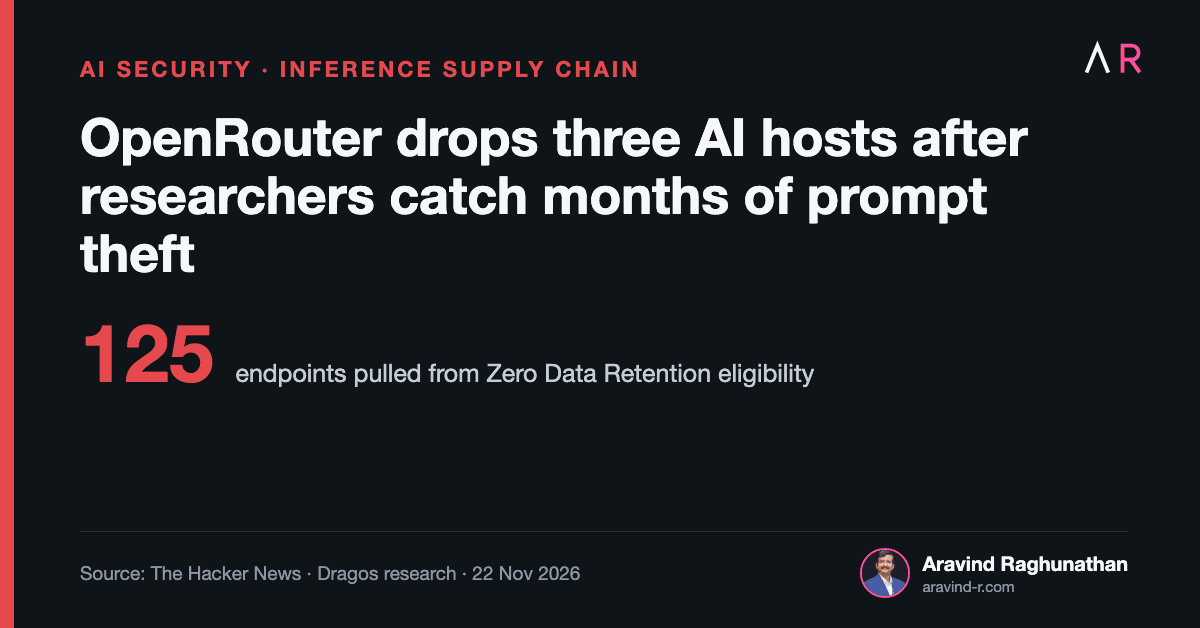
Three AI inference providers had attackers inside their systems for months, and none of them knew until researchers told them. That is what Dragos found, the industrial cybersecurity firm, and the findings have pushed OpenRouter, the gateway that routes customer AI requests to a pool of third-party providers, to remove the three providers from its platform.
OpenRouter also removed 125 endpoints from Zero Data Retention eligibility, as a precaution covering the flagged providers and others, and notified every potentially affected customer. It says its own systems were not breached.
How the theft was caught
Dragos seeded about two million prompts with unique web links and credentials between July and November, then watched for anyone using them. Each planted secret existed in exactly one prompt, so any use of it proved someone had read that prompt.
Here is what turned up:
- The earliest breach began in mid-July. The bait prompts were processed alongside real customer requests, and the firm says those were almost certainly copied too.
- In the largest case, every request in the test windows was stolen. That included requests the provider rejected before any model ran, meaning traffic was being copied at the point of arrival.
- Stolen AWS keys were used within hours. The attacker listed S3 buckets, searched Secrets Manager and Parameter Store, and tried to create Bedrock API keys and add IAM users to keep access.
- Zero Data Retention didn't help. Some stolen requests carried that flag. As HD Moore, Dragos's chief research officer, wrote, a privacy flag doesn't help once the attacker is already inside.
The research also found marketplace sellers listing models at the lowest prices with request logging switched on, simply collecting what flowed through. And it traced prompts sent to one unnamed Chinese AI lab's models, including requests marked for no data collection, back to that lab's scraper.
What this means for enterprise AI teams
Most AI governance programmes focus on the model vendor. Here the risk sat further down the chain: in the hosting provider, the router, and any hop in between that nobody disclosed.
A few steps follow from this. Treat a retention setting as a contractual promise, not a technical control, and verify it. Keep secrets out of prompts, and assume any credential that has been in one is exposed. And ask your gateway for the actual network path your requests take. OpenRouter says it is now building the researchers' canary method into continuous checks. Nothing stops your own team running the same test.