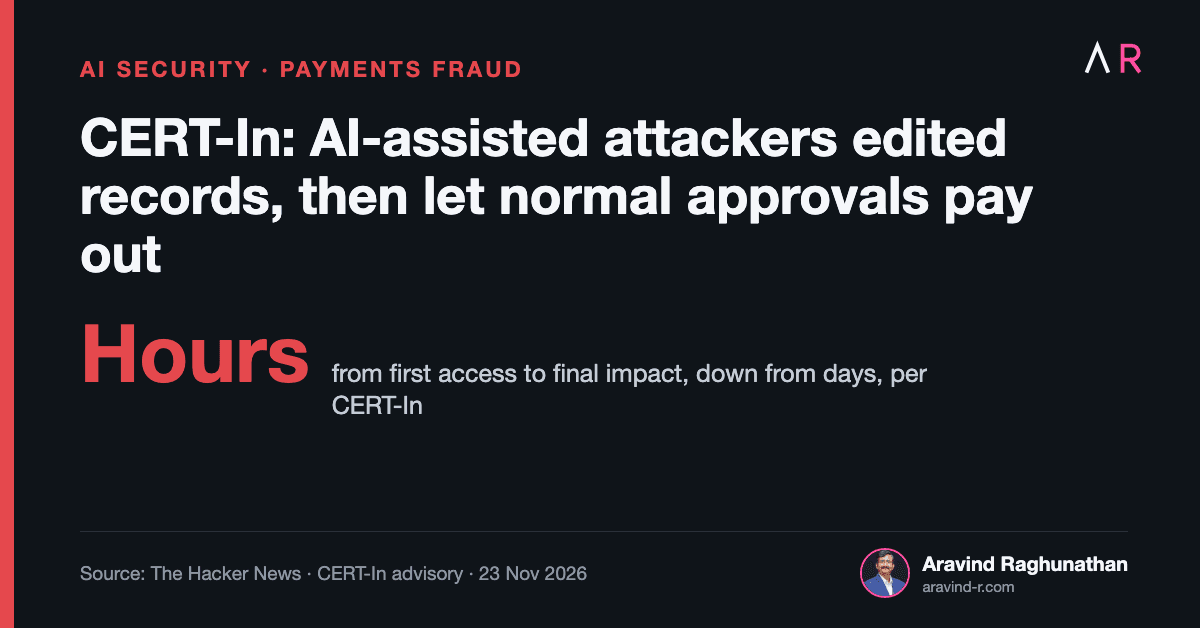
CERT-In has described an attack pattern that most payment controls weren't built to catch. Attackers did not break the payment systems. They changed the records those systems trust, then let the normal approval process pay out.
What CERT-In found
According to a CERT-In advisory reported by The Hacker News, AI-assisted attacks on Indian ICT assets led to unauthorised transactions at banks, financial services firms and technology providers that support government-linked payments and vendor or partner payouts.
The methods CERT-In listed were:
- Abusing business applications and workflows run by service providers, rather than attacking payment APIs directly.
- Changing business records or approval relationships, then using legitimate payment processes.
- Pushing unauthorised transactions through trusted systems and established approvals without raising alerts.
- Exploiting weak spots in independent verification, reconciliation and review of changes to records.
CERT-In did not say how much money was lost or who was behind it. In its words, "agentic tooling compressed the time between initial access and final impact from days to a few hours."
Agents doing the reconnaissance
The advisory also describes AI-driven agentic offensive frameworks being used across enterprise, government, academic and research networks. These tools automate reconnaissance, quickly build or modify exploits for known vulnerabilities by analysing patches, run several agents in parallel on intrusion tasks, and change tactics when they are blocked.
This follows CERT-In's earlier warning about the Crafty Falcon group and its use of tools such as ARTEX against financial firms. The Indian Cybercrime Coordination Centre separately says attacks on banks, NBFCs and fintechs have produced multi-crore unauthorised transfers to mule accounts.
Why this one is different
Most fraud controls look for something odd: a strange API call, an unknown device, a transaction outside policy. This pattern produces none of those signals. The vendor record is edited, the approver chain looks normal, and the payment goes through the system exactly as designed.
That puts much of the defence in process, not tooling. Changes to vendor master data and approval hierarchies need independent review. Reconciliation has to catch records that changed shortly before a payout. Service-provider workflows need the same monitoring as your own. Incident response plans should assume an intrusion that moves from access to impact in hours, not days.
A simple test: can your finance team say who changed a vendor's bank details last week, and who checked the change? If not, that is the first gap to close.