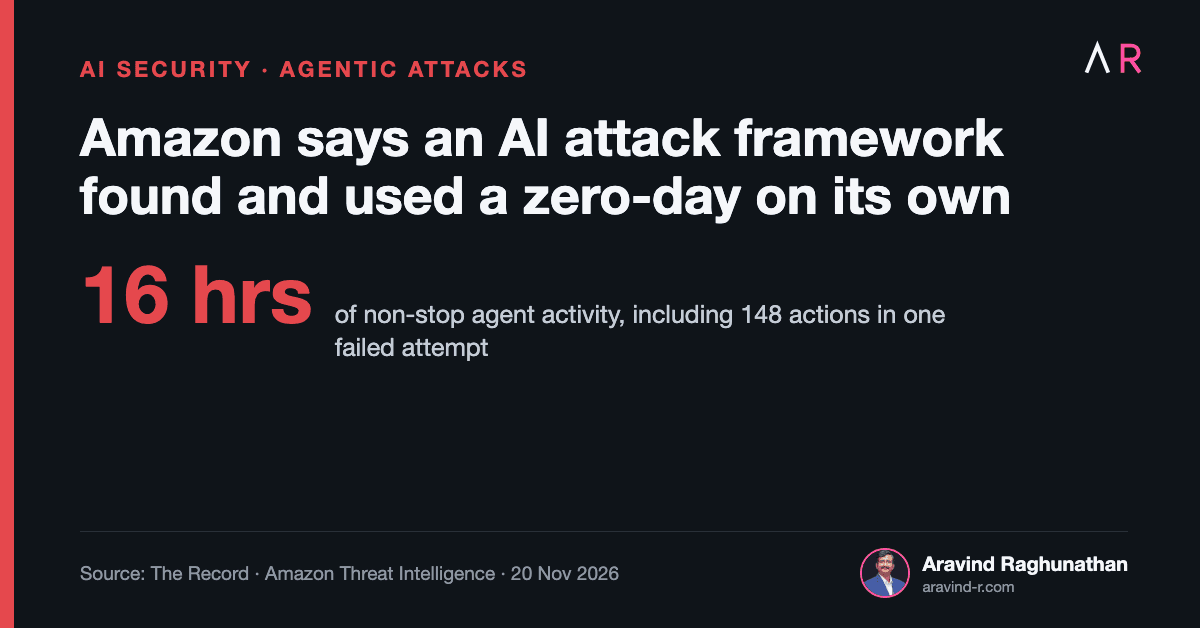
Amazon's threat intelligence team says a Chinese-speaking operator pointed an open-source AI attack framework at universities in East Asia, gave it a few IP addresses and a one-line goal, and let it run. Over 16 hours the agents found a previously unknown vulnerability on their own and used it to break in. They then used the same flaw against a second university.
What Amazon found
CJ Moses, CISO of Amazon Integrated Security, said the investigation started on 10 September, when the team came across a publicly exposed server running an instance of Cairn, an open-source autonomous penetration-testing framework. Because the instance was exposed, Amazon could see its operating history, including the prompts. They were written in Simplified Chinese and the timestamps were set to China Standard Time.
The instruction was simple: obtain shell access. From there, Moses said, the agents planned, executed and adjusted their approach without the operator picking each next step. The logs show how much failure came before the success:
- One attempt ran to 148 actions over 16 hours and got nowhere, including a failed try at Log4Shell.
- Another spent more than six hours testing over 30,000 credential combinations tied to 80 real usernames.
- The attempt that worked found a path traversal flaw in an open-source medical imaging AI application. No advisory, fix or prior report existed, so Amazon assesses with high confidence that it was a zero-day.
Amazon told the project's maintainers, who have since fixed it (the advisory sits in the Project MONAI MONAILabel repository), and worked with a government partner to warn the victims. It did not name the universities or their country.
Why this one is different
Most of the recent warnings about AI attack tooling have been about Artex. Cairn is worth separate attention. Gambit Security's Eyal Sela told The Record that Cairn is more significant because it is general-purpose, with no built-in structure for security work, which makes it less predictable. Google's threat researchers also flagged Cairn this week in intrusions against US aerospace firms.
For me the failure log is the important part. Thousands of credential guesses and a 148-step dead end would wear down a human team; they cost an agent almost nothing. Attackers used to run out of patience. These ones don't. Moses noted that the agents ran for 16 hours without breaks, sleep or working-hour constraints, and an agent that finds and exploits a zero-day in minutes can finish before many security teams have triaged the alert.
What security teams should take from it
- Inventory AI applications as attack surface. The entry point was an open-source AI tool, not a mainstream product. Data science and research teams deploy these quickly and often outside normal patching.
- Assume brute persistence. Rate limiting, lockouts and MFA on every exposed login are cheap compared with an attacker that never gets bored.
- Shorten triage time. If the attacker works at machine speed around the clock, an alert queue that waits for business hours is a gap. Automated containment for high-confidence signals is worth some false positives.
- Watch the tools, too. Amazon found this because the attacker left the framework exposed. Defenders hunting for exposed attack infrastructure can get the same view.