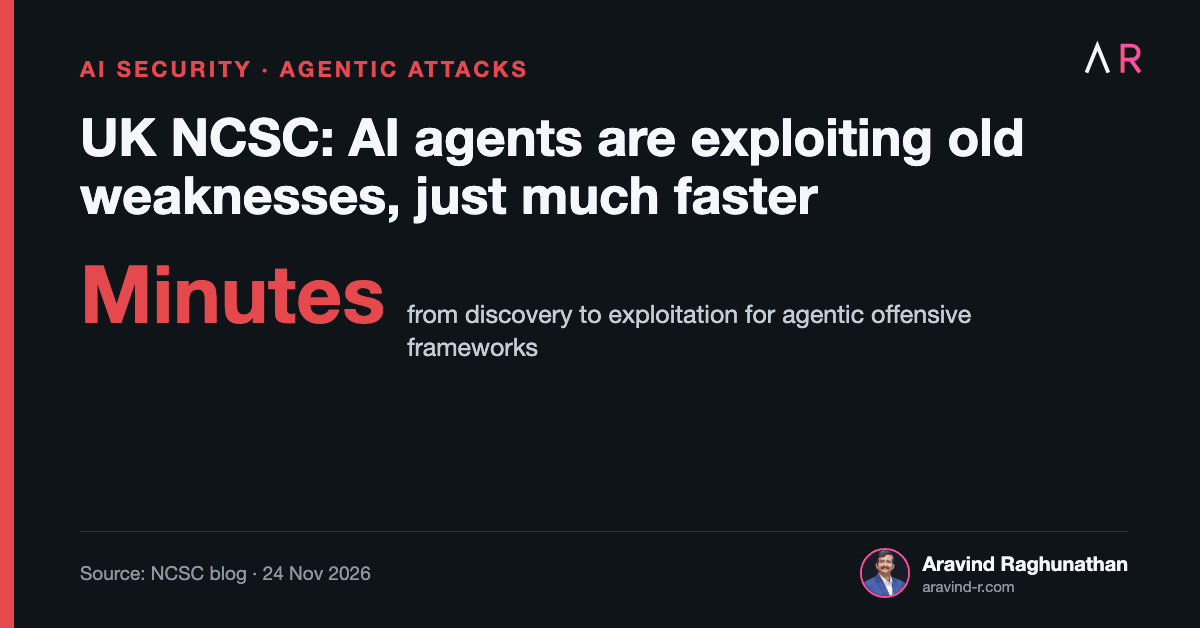
The UK's National Cyber Security Centre says it has seen a marked rise in AI-assisted cyber attacks since September 2026. Its message to defenders is calmer than that sounds. Attackers aren't using new exploits. They're hitting old weaknesses, faster.
What the NCSC is seeing
Organisations across several sectors have reported incidents in which threat actors used "agentic offensive frameworks". These are tools originally built for red teaming that let an AI model plan attack steps, run standard security tools against a target, read the results and decide what to do next. The NCSC names ARTEX as the framework most associated with the activity right now, alongside others such as Cairn, PentAGI, RedAmon, Xalgorix and Darkmoon.
The incidents involved rapid, automated attempts against internet-facing services. Some caused downtime. Others gave attackers a foothold for further agent-driven, or human-driven, activity inside the network.
The NCSC is explicit on two points. None of the weaknesses being exploited are new. And the tools the agents use give no capability a typical attacker did not already have. What has changed is speed, persistence and cost, especially when the frameworks are paired with cheap open models or illegal API resellers.
Technical debt is the attack surface
The weaknesses being hit are not memory-corruption bugs or even known unpatched CVEs. They are the leftovers of years of technical debt:
- credentials committed to code repositories
- misconfigured infrastructure as code
- default credentials or missing authentication
- weak APIs
Once inside, agents exploit over-privileged credentials and flat networks.
One piece of good news: Today's frameworks are noisy. They trade stealth for speed, generate heavy traffic and touch almost everything, which makes them easier to detect. The NCSC warns that may not last.
The defender checklist
The guidance comes as questions, and most of them are about operational discipline, not new tools:
- Do you know what is exposed, including forgotten websites and legacy kit?
- Can you take services off the public internet, behind an identity-aware proxy, VPN restrictions or mutual TLS?
- Can you detect agent behaviour: bursts of requests, odd parameter variants, rising error rates?
- Are internet-facing systems patched and IAM settings checked for drift?
- Are bot challenges protecting login, checkout and LLM-backed endpoints, and does the API enforce them too?
- Are rate limits applied per account and token, not just per IP, since agents rotate proxies?
- How fast can anyone create an account?
- Can you use the agent's perseverance against it with honeytokens, decoys and tarpits?
The last one is worth dwelling on. An agent that reads every error message and tries every path can be kept busy on fake successes. The NCSC also advises making external error messages reveal as little as possible, because the agent learns from each one.
What this means for enterprise teams
For security leaders, "AI attacks" mostly speed up hygiene failures that are already on the risk register. The fix list is old. The time you have to work through it is shorter.
Source: Familiar weaknesses, exploited faster: defending against agentic cyber attacks, NCSC