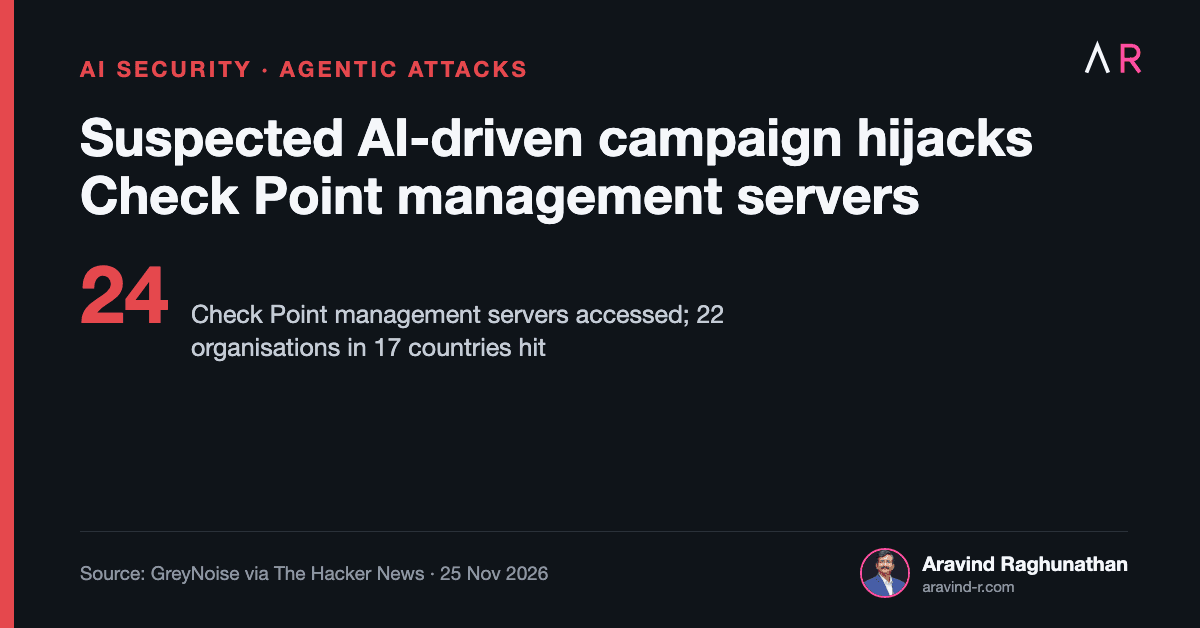
An unknown attacker has been working through Check Point Security Management servers using what researchers believe is an AI-driven offensive toolkit. GreyNoise, which tracks the actor as GreyNoise Threat 13 (GT13), says the campaign hit 22 organisations across 17 countries, India among them.
The confirmed activity ran from 17 October to 2 November 2026. The targets were in financial services, energy, government, transportation, mining, engineering and manufacturing.
What the attackers did
GT13 used 99 IP addresses, all either egressing through ExpressVPN or running from Check Point devices it had already compromised. GreyNoise logged more than 1,400 network sessions, 800 command-line artefacts and 1,200 files downloaded, uploaded or created.
In one case, an automated scan-and-exploit pipeline took over a Rejetto HFS server through a critical flaw (CVE-2026-61500) and planted an SSH key for persistent root access. The attackers then used that server as a relay to pull command results and data from 24 Check Point Security Management servers they already controlled.
Inside one victim network, they used a script for a now-patched Check Point flaw (CVE-2026-16232) to launch more than 100 management tasks. Those tasks:
- stole firewall databases and internal certificate authority files
- minted a new certificate
- unloaded security policies, which switched off firewall protection
- ran internal reconnaissance and tried to move laterally
They also went after older, well-known bugs in Citrix NetScaler, Ivanti Connect Secure, VMware vCenter, Microsoft Exchange and Netlogon.
What nobody can explain yet
GreyNoise says GT13 already had access to the Check Point servers before it compromised the HFS relay, and it couldn't work out how or when that access began. The researchers believe the actor runs a "mature AI-enabled offensive apparatus" using agentic tooling to scan, exploit and interact with compromised systems.
Check Point's threat intelligence director, Sergey Shykevich, told The Hacker News the activity involves a previously disclosed vulnerability with patches already out, and no new exploitation technique.
Read that statement again. No zero-day was needed. The attacker won on speed and scale against old, unpatched weaknesses, and the prize was the management plane of the firewall itself. If your security management servers can be reached from the internet, or run behind on patches, close that gap this week.