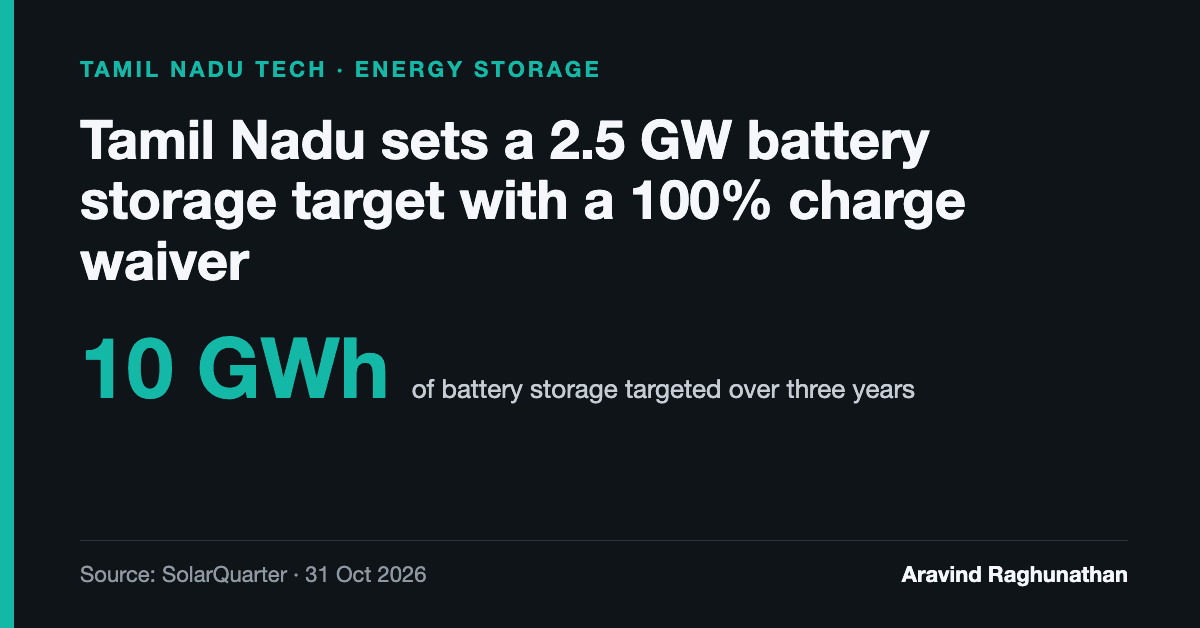
Tamil Nadu has put out a dedicated Battery Energy Storage Systems (BESS) policy that targets at least 2.5 GW, or 10 GWh, of storage capacity over the next three years.
What the policy does
Standalone and co-located storage. The framework covers both independent battery installations and storage built alongside renewable projects. Anything from 1 MW upwards qualifies, so independent storage developers can play as well as generators.
A 100% waiver on transmission and wheeling charges. Eligible BESS projects that charge from clean energy and discharge to meet peak demand pay no transmission or wheeling charges. For a storage project, that is a big line item gone.
Storage becomes mandatory for new solar. New solar and hybrid plants of 1 MW and above will have to include battery storage, sized as a set share of generation capacity with a defined multi-hour discharge duration. Existing plants are encouraged to retrofit.
Why it matters
The problem being solved is timing. Solar output peaks at midday; Tamil Nadu's demand climbs in the evening. Batteries let the grid store the daytime surplus and release it after sunset, which cuts curtailment, eases pressure on transmission lines and makes peak supply more reliable.
There is a technology story here too, though the policy itself doesn't spell it out. Grid-scale storage runs on battery management systems, forecasting and dispatch software, and that software increasingly uses machine learning to predict solar output, demand peaks and battery wear. A mandated 10 GWh pipeline is a large, steady market for exactly that kind of software and for the engineers who build it, many of them already in Chennai and Coimbatore.
It also ties into the state's manufacturing push. The policy is expected to open investment across battery manufacturing, project development and energy management. Tamil Nadu has been building EV and electronics capacity for years, and battery work sits next to both.
What to watch
The details that decide how fast this moves are the exact storage percentage and discharge duration for new plants, and how the waiver is verified. "Charged from clean energy" has to be measured somehow. Those will show up in the implementation orders.