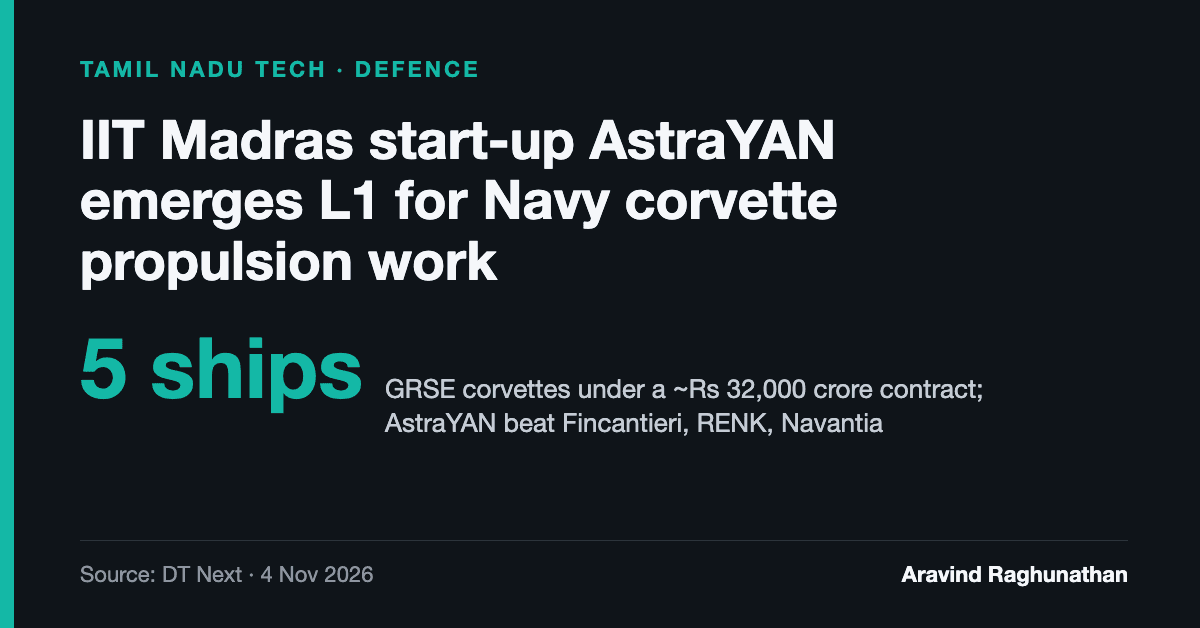
AstraYAN, a Chennai start-up incubated at IIT Madras, has emerged as the lowest bidder (L1) for propulsion system integration on five Next Generation Corvettes that Garden Reach Shipbuilders and Engineers (GRSE) is building for the Indian Navy, according to DT Next.
The tender
It was a globally competed tender that drew five participants, including Italy's Fincantieri, Germany's RENK and Spain's Navantia. Three companies qualified for the final stage after technical and commercial evaluation. AstraYAN was the only Indian company to qualify, and it came out L1.
The selection took more than a year. Technical evaluation involved the Indian Navy, the Naval Science and Technological Laboratory (NSTL) under DRDO, and the shipyards.
What the work is
Propulsion integration means bringing the propulsion machinery, transmission and control systems together into one operating system. The corvettes will use a Combined Diesel and Gas Turbine–Cross-Connect (CODAG-CC) arrangement, which combines diesel engines and gas turbines to meet different operational requirements.
This is systems engineering rather than fabrication, and it is one of the areas where India's warship programmes have still depended on foreign suppliers.
AstraYAN founder Amit Batra said sovereign control over a vessel's core design and technologies is essential, and that start-ups can help close the gaps through sustained work with the Navy and shipyards.
The bigger contract
The Defence Ministry signed contracts worth Rs 53,866.50 crore on 2 November for eight Next Generation Corvettes. GRSE will build five under a contract worth about Rs 32,000 crore, and Goa Shipyard Limited will build the other three.
Why it matters for Tamil Nadu
Chennai's tech story is usually told through electronics manufacturing and GCCs. This one is different: a campus-incubated company competing on engineering against European primes, after an evaluation that ran more than a year.
Being L1 is not the same as a signed contract, and the integration work itself will be the real test. Still, a start-up clearing Navy and DRDO evaluation and finishing ahead of Fincantieri is a result Tamil Nadu's deep-tech founders will pay attention to.