Chief Minister C. Joseph Vijay's government has set a target of taking Tamil Nadu's economy to $1.5 trillion by 2036. In an opinion piece for DT Next, Debdulal Thakur, Professor and Director of the Centre of Excellence for Public Policy, Sustainability and ESG at Alliance University, argues the state has earned the right to aim that high, but needs a second scoreboard to show what the number actually means.
The base is real
The figures he cites back the ambition:
- Real growth of 11.2% in 2024-25, with manufacturing up 14.74%, per the state's Economic Survey.
- Nominal GSDP revised to Rs 35.68 lakh crore for 2025-26, and projected at Rs 40.67 lakh crore for 2026-27.
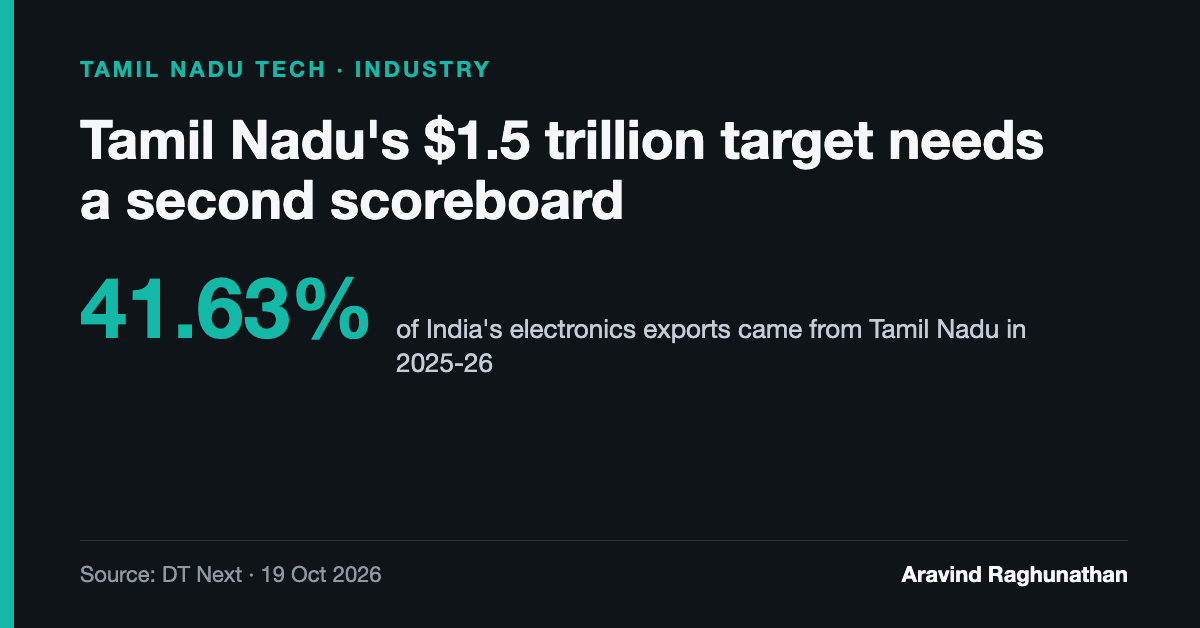
- Merchandise exports of $58.95 billion in 2025-26, including 41.63% of India's electronics exports and 33.38% of motor-vehicle exports, according to figures supplied to Parliament.
- 40.3% of India's directly employed women factory workers in 2024.
The arithmetic is steep, though. Thakur works out that hitting the target implies roughly 15.4% to 17.1% annual nominal growth for ten years, depending on where the rupee sits.
Exports are not the same as capability
His sharpest point is about electronics. The selling price of an exported phone includes imported chips, foreign designs and components made elsewhere. Gross exports are not locally generated income.
Thakur doesn't dismiss assembly. It teaches process discipline, employs people and attracts suppliers. The question is whether the ladder leads upward, into engineering, tooling and design, or whether the state stays exposed when a multinational moves its lines elsewhere.
His fix: ask anchor firms in the electronics and automotive clusters which inputs local suppliers keep failing to qualify for, then fund shared testing labs, precision tooling and certification help. Tie public support to verifiable results, such as suppliers meeting standards and winning repeat orders, and stop paying for failure.
Measure outcomes, not announcements
The same discipline runs through the rest of the piece:
- Investments: Guidance Tamil Nadu and SIPCOT could publish annual cohorts of major pledges showing financial closure, commissioning, money actually invested and two-year job retention.
- AI skilling: The 2026-27 budget plans to train five lakh young people in AI by 2031. Thakur wants completion, practical assessment, placement and earnings published, not just participant counts.
- Infrastructure: Coimbatore, Hosur, Madurai and Tiruchy can absorb growth only if transport, drainage, water and housing come before demand. Clusters should report real outages and connection times.
What it means for tech in the state
I think this frame is right for anyone building or buying technology in Tamil Nadu. A large share of India's electronics already leaves the country from here. The next step is keeping design and engineering work in the state as well, and making sure AI skilling produces people who can do the job. A public scorecard is how we'd know whether either is happening.