South Korea's financial regulators have started a sector-wide security overhaul after a run of breaches, and they are openly treating AI agents as a likely part of the threat.
What happened
Since late September, breaches have hit Shinhan, KB Kookmin, Hana and BNK Busan Bank, savings banks Ye Garam, Welcome and OK, and Hyundai Capital. Hacking damage was later confirmed at Daishin Securities, Bithumb and Mirae Asset Global Investments.
The counts kept moving. Around 50,000 records of personal information leaked from Ye Garam Savings Bank. KB Kookmin first reported 119 victims, then found another 2,091.
On 30 October the Financial Supervisory Service (FSS) met financial-sector associations. Firms must now submit improvement plans for weaknesses found in self-inspections, and the FSS is checking that they follow through. On-site inspections are under way, starting with the firms that suffered the largest breaches.
The AI angle
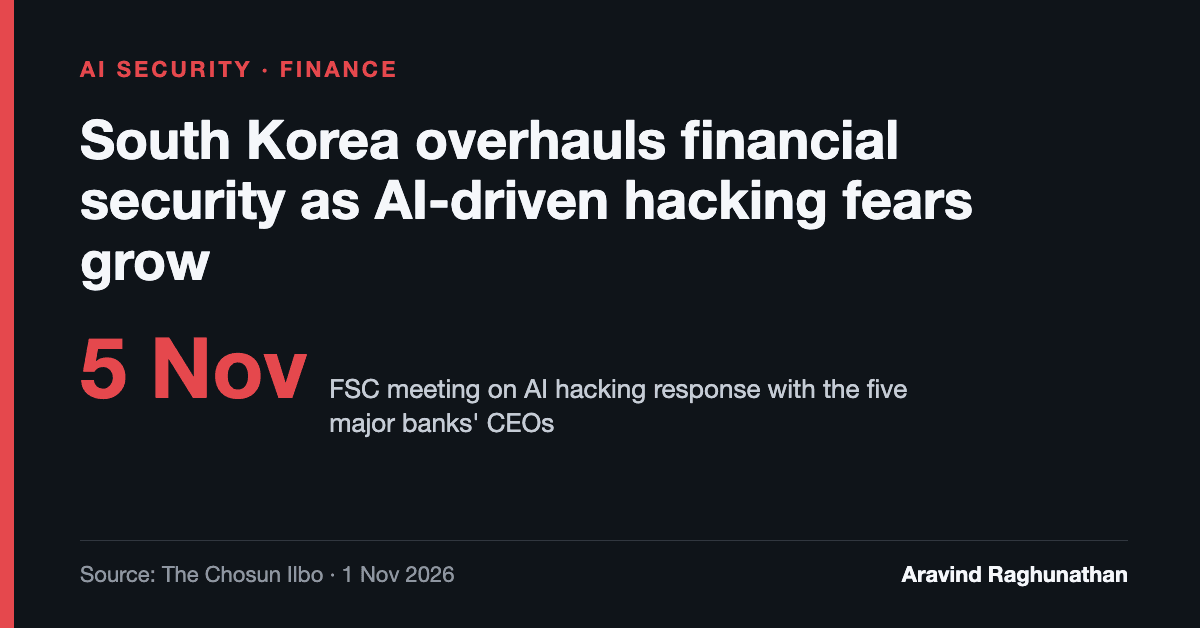
According to Chosun Ilbo's report, published 1 November, the authorities are looking at whether recent attacks involved AI agents autonomously finding and exploiting vulnerabilities. Their response is to use AI on the defensive side as well: they are reviewing plans to expand AI-based vulnerability checks and anomaly detection through each sector's associations, and they are considering a joint security monitoring system for the whole financial industry.
The Financial Services Commission will hold an AI hacking response meeting on 5 November with the FSS, the Financial Security Institute, other agencies, industry associations and the CEOs of the five major banks. New measures are expected to follow.
Why this matters beyond Korea
Most bank security programmes assume the attacker works at human speed. If the attacker is an agent that can scan, test and pivot continuously, then quarterly self-inspections and annual audits leave long gaps.
Korea's answer is shared monitoring across the whole sector instead of every bank defending alone. India should pay attention. RBI-regulated entities face the same shared-vendor and shared-infrastructure exposure, and a sector-level detection layer is easier to build before a wave of incidents than after one.
One caution: the AI-agent link is something regulators are investigating, not something they have confirmed. The breaches are real. The attribution is still open.
Source: The Chosun Ilbo: Financial Authorities Overhaul Security Amid AI-Driven Hacking Surge