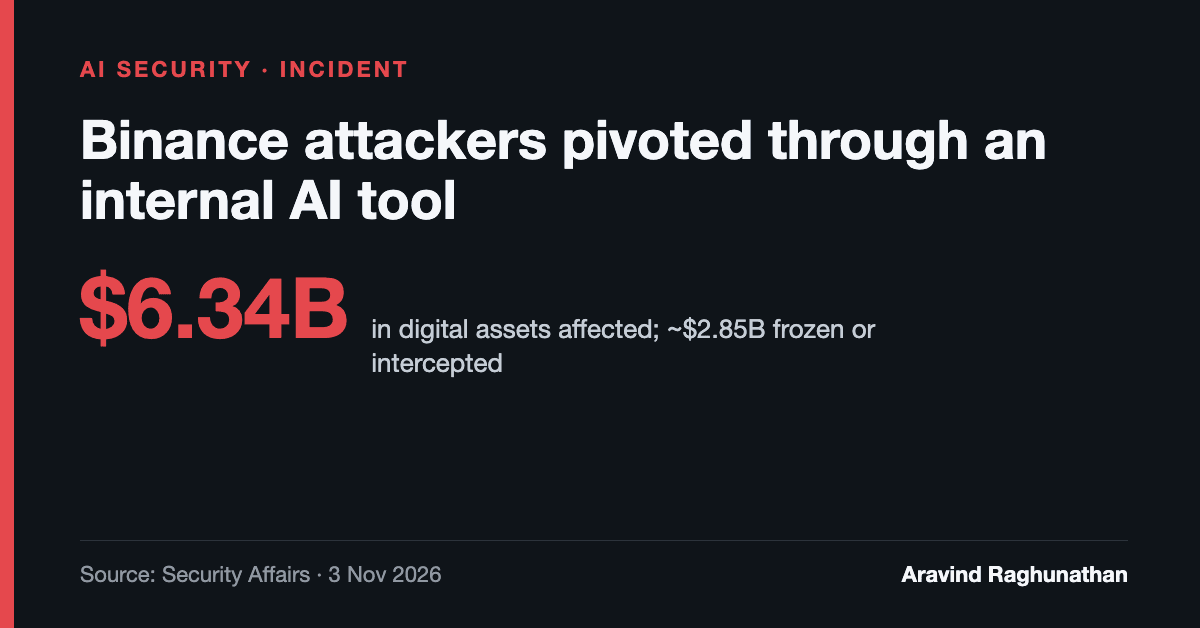
Binance has published its first account of the 29 October theft, and the route the attackers took should worry any company rolling out internal AI tools. The exchange estimates about $6.34 billion in digital assets were affected. The FBI has attributed the attack to the North Korea-linked group TraderTraitor, also tracked as Lazarus Group and APT38.
How it unfolded
Binance called it "a sophisticated, multi-stage campaign," not a single breach.
- June 2026: an engineer on the Wallet DevOps team downloaded a tampered Homebrew installation while searching for a popular AI coding tool. Binance caught it, replaced the device and rotated credentials, but details of the engineer's role and colleagues had already leaked.
- September: a second engineer was approached through a legitimate job platform. After two fake interviews, one with an "HR representative" and one with a supposed CEO, he was asked to download a coding assignment onto his work computer. The repository ran malicious code during setup. Binance says its endpoint tools did not detect it.
- 20 October: from that machine, the attackers abused an internal AI tool to gain control over the systems of two more employees, including the engineer first targeted in June. His computer held a token with container deployment permissions.
- 29 October: using stolen credentials, they deployed a container and ran a script that reached Binance's internal wallet signing service, then moved funds outside the normal withdrawal process.
The attackers also used Ethereum's EIP-7702 mechanism to give their own smart contract partial execution rights over a hot wallet. Because those authorisations already lived on-chain, suspending withdrawals did not stop the transfers. The last one finished at 23:56 UTC, and Binance cleared the malicious authorisation at 00:10 UTC on 30 October.
As of 3 November, about $2.85 billion had been frozen or intercepted. Binance says it will absorb the loss and had replenished 98% of affected token assets by 31 October.
The AI tool was a pivot, not a flaw
Security Affairs draws a distinction worth keeping. Binance's report does not describe a vulnerability in an AI model. The internal AI tool became an attack path because it carried the access of whoever was logged in, and the attacker was logged in as a compromised engineer.
For enterprises, this is the part to take away. An internal assistant that can reach other employees' machines or deployment systems inherits every permission it is given. If one account falls, the assistant's reach falls with it.
A few controls follow directly from that:
- Treat internal AI tools as privileged systems, with least-privilege access and logging.
- Keep deployment tokens short-lived and off developer laptops.
- Run take-home coding tests and unknown repositories in isolated environments, never on work machines.
Binance also says it detected and blocked 57 suspected North Korea-linked threats this year, many of them fake job interviews. Hiring pipelines belong in the threat model now.
Source: Binance Hack: How Fake Job Interviews and AI Abuse Led to a $6.34 Billion Attack, Security Affairs