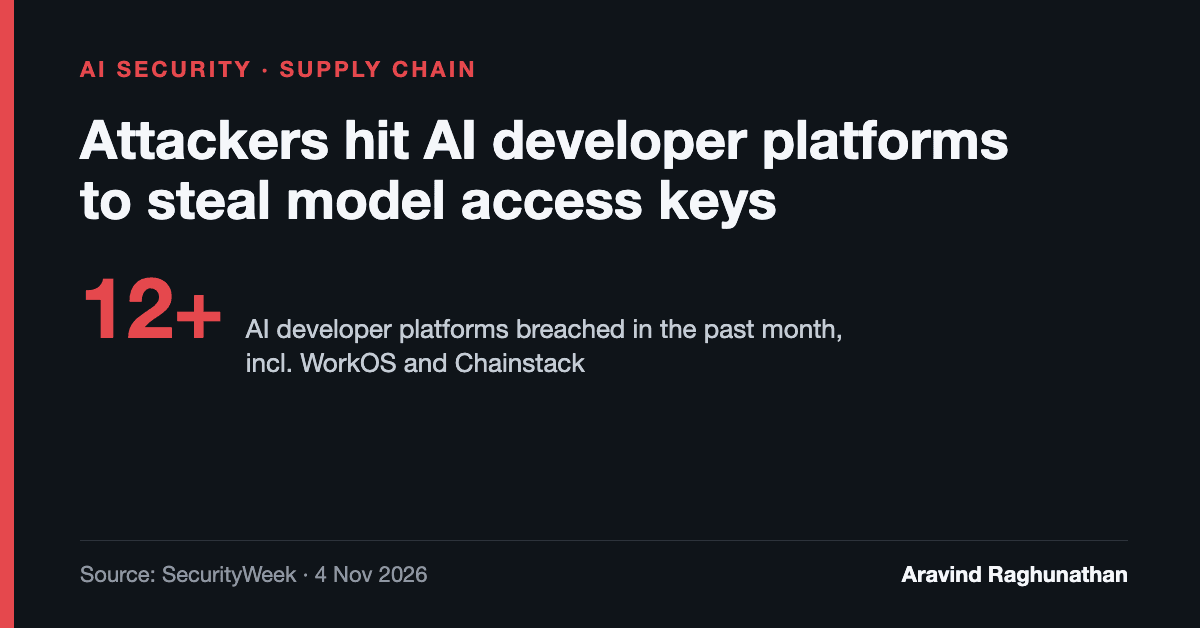
According to SecurityWeek, at least a dozen AI developer platforms were breached in that time, and in almost every case the attackers were after AI access keys they could resell.
Who was hit
The most recent disclosures came from CommandCode, Northflank, Trigger.dev, Chainstack and WorkOS. The wider list also includes Andromeda, Brev (NVIDIA), Fireworks AI, Lightning AI, OpenCode, Railway, Warp and Zeabur. In most cases the intruders were looking for stored customer secrets.
The incidents don't appear to be linked, and the way in varied: compromised credentials, third-party dependencies and exploited vulnerabilities all show up.
Two of this week's disclosures have more detail:
- Chainstack was hit on 26 October through a third-party component. The attackers reached a development environment and parts of production, including a database with organisation names, account holder names, member email addresses and password hashes. Customers were told to rotate node credentials.
- WorkOS says that on 30 October attackers compromised an internal application used by its sales team and accessed business contact details and summaries of customer communications.
Both companies tied their attacks to Artex, an open-source AI penetration testing framework used to automate the intrusion. Several firms have linked Artex to Storm-0940, a Chinese APT.
Why AI keys are the prize
Wiz, which analysed the incidents, puts the surge down to LLM-jacking and LLM broker infrastructure, which make stolen AI tokens easy to monetise. It also points to demand from distillation, training a cheaper model on a stronger model's outputs.
Wiz saw the stolen keys being used fast. In two cases the first unauthorised activity came within 30 minutes of the credential access at the vendor, and several threat actors used the same keys, which suggests an active market for them.
The Cloud Security Alliance pointed out why this layer is attractive: hosting platforms, evaluation services and developer consoles hold credentials on behalf of many customers, so one intrusion can expose keys for many inference accounts at once.
What to check this week
- Know where your AI keys live. List every platform holding a model provider key on your behalf: CI, hosting, eval tools, agent frameworks, gateways.
- Rotate anything stored with an affected vendor. Don't wait for the vendor's email.
- Scope and cap keys. Per-project keys with spending limits turn a stolen key into a bounded loss.
- Watch usage, not just access. An unexplained spike in token spend is often the first sign a key is in someone else's hands.
If a tool can call a model on your account, it belongs in your AI supply chain review.
Source: AI-Linked Breaches Mount as WorkOS, Northflank, Trigger.dev Disclose Hacks, SecurityWeek