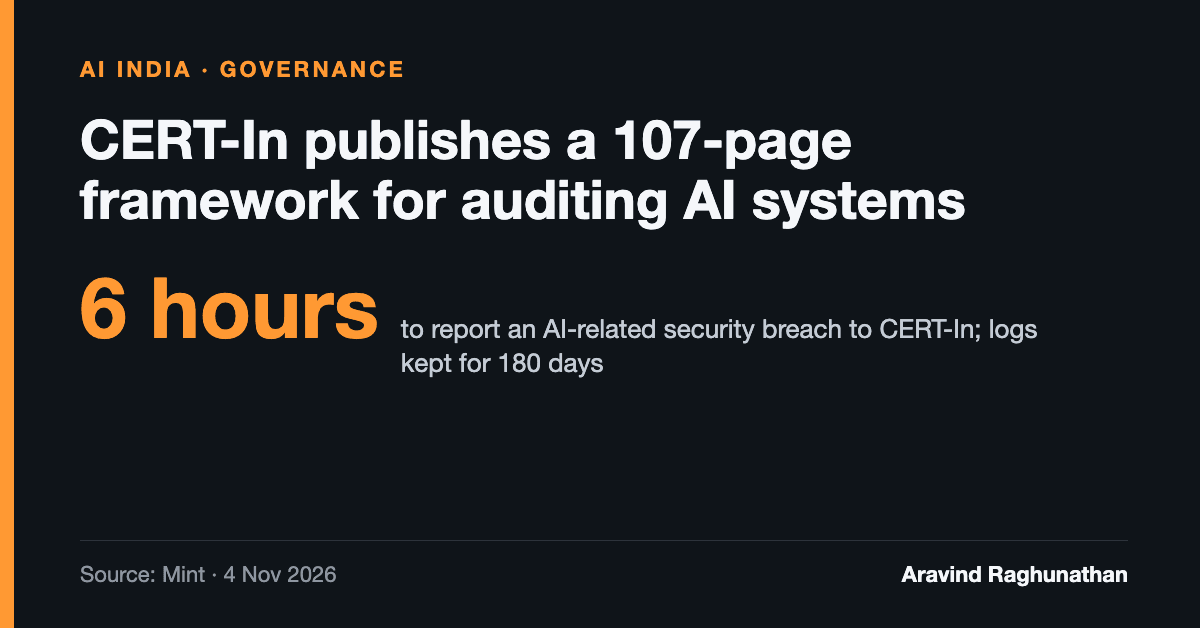
On 4 November CERT-In published a 107-page document called Artificial Intelligence Security Auditing Guidelines: Framework for Secure, Ethical and Auditable Artificial Intelligence Systems. The document sets out minimum security, transparency and accountability expectations for anyone building or deploying AI in India, including the US companies behind ChatGPT, Claude and Gemini.
What the guidelines ask for
The framework covers about ten areas where companies building AI models and applications are expected to meet set standards. Two of the requirements are concrete enough to plan around:
- Six-hour breach reporting. AI-related security incidents should be reported to CERT-In within six hours.
- 180 days of logs. Companies should keep logs of their AI systems' usage and operations for 180 days.
At the centre is a classification scheme. AI models and applications would be placed in one of four criticality tiers (low, moderate, high and critical) based on eight identifiers, including how severe the potential impact is and how sensitive the data is. The framework also expects independent audits and security assessments, scaled to the "nature, scale, autonomy and potential impact" of each system.
Binding for whom?
The guidelines are not law for AI companies. They are binding on cyber security auditors empanelled with CERT-In, and those auditors will use them whenever they examine the AI systems inside large companies that need to pass a security audit.
That makes them more than advice. If your organisation goes through a CERT-In empanelled audit, your AI systems will now be judged against this framework, whether or not a law ever follows. An official told Mint that the question of turning it into law is "a completely separate matter" being worked on inside MeitY.
Jibu Elias of the Mozilla Foundation told Mint the approach mirrors existing EU and NIST work, pointed out that Tamil Nadu already had a Safe & Ethical AI Policy in 2020, and said non-binding guidelines rarely change much on the ground. Experts also noted that the risk tiers and audit structure look a lot like the EU AI Act, minus the legal force.
This is the second AI governance framework in under a week. On 30 October, iSPIRT and MeitY unveiled the Data Empowerment and Protection Architecture (DEPA) for AI.
What I'd do with this as a CIO or CISO
- Inventory first. You can't tier what you haven't listed. Most enterprises still don't have a complete register of the models, copilots and agents running in their estate.
- Do a rough tiering now. Use the four levels and ask which of your AI systems touch sensitive data or make decisions with real impact. Those are the ones an auditor will look at first.
- Check your logging. Keeping 180 days of usage and operations logs is a storage and design decision. Many AI tools bought as SaaS don't give you that by default.
- Rehearse the six-hour clock. Most incident processes were not written with a prompt-injection or model-data leak in mind. Find out who would make that call and how.
My read: these questions will turn up in an audit report sooner than most teams expect, so it is cheaper to answer them now.
Source: Centre issues transparency, safety guidelines for AI, Mint