For two years the AI trade has pulled global money toward a handful of US technology companies. Jefferies now thinks that flow may be turning, and that India is the emerging market most likely to gain.
What Jefferies is saying
In its latest GREED & fear strategy report, Jefferies says investors are beginning to ask whether the scale of AI spending by big US tech firms is earning its keep. The median forecast return on invested capital for four large US technology companies has dropped from 21.7% to 16.8% for 2027, even as their capital spending is expected to keep rising.
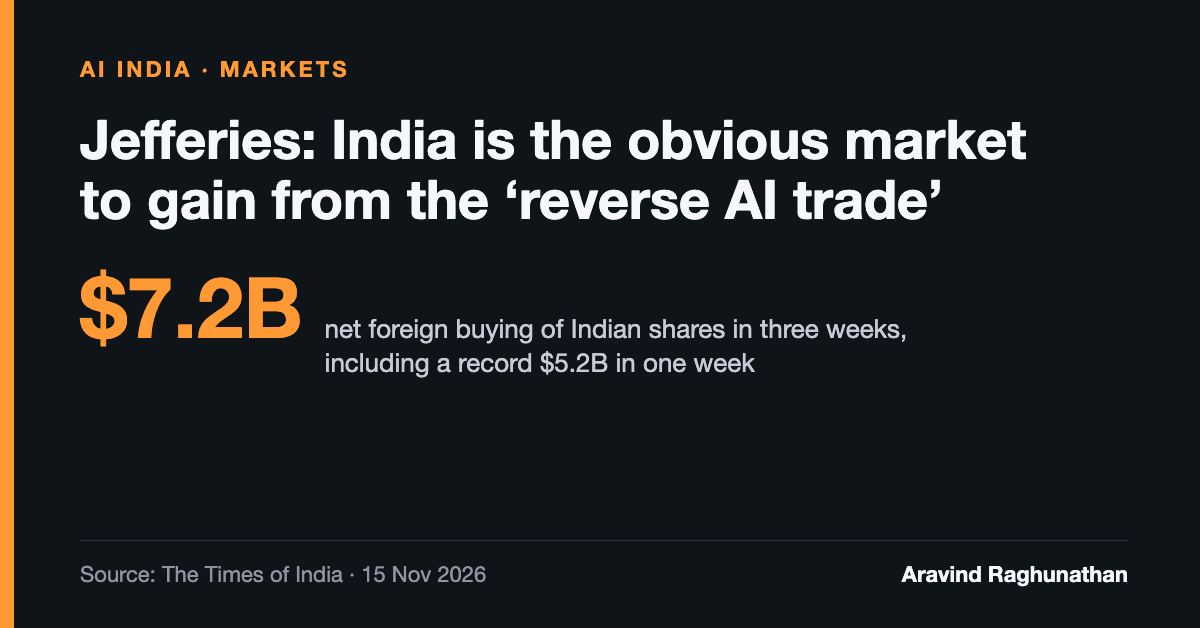
If that doubt grows, fund managers have a reason to look beyond tech stocks. Jefferies' view is that India is "the obvious market" in emerging markets to benefit.
The flows have already moved
Foreign investors bought a net $7.2 billion of Indian shares over three weeks, according to the report, including a record $5.2 billion in the week ended November 6. That follows a long stretch of selling: net outflows of $32.4 billion since the start of 2026 and $51.2 billion since the start of 2025.
Jefferies also points to two domestic supports:
- Valuations that are modest relative to history. The Nifty was trading at 18.4 times expected one-year earnings, and the Nifty MidCap 100 at 23.1 times.
- Private investment is picking up. Machinery imports, a proxy for capex, rose from $29 billion in FY21 to $62 billion in FY26, and to $67 billion in the 12 months to September 2026.
Domestic money has kept coming too. Equity mutual fund inflows were Rs 350 billion in October and Rs 3.9 trillion for the first ten months of 2026. The brokerage did note that a heavy supply of new equity has capped index gains.
Reading it as an AI story
This isn't a call on any stock. I read it as a signal about the AI cycle. When the people funding AI infrastructure start pricing in lower returns, that pressure reaches every enterprise buying AI. Show the productivity gain, or the budget gets harder to defend.
For Indian companies the effect is mixed. Returning foreign money helps. But the question investors are now asking US hyperscalers, where's the return, is the same one Indian boards will ask about their own AI programmes. Companies that can answer it with numbers are better placed to gain from the shift.