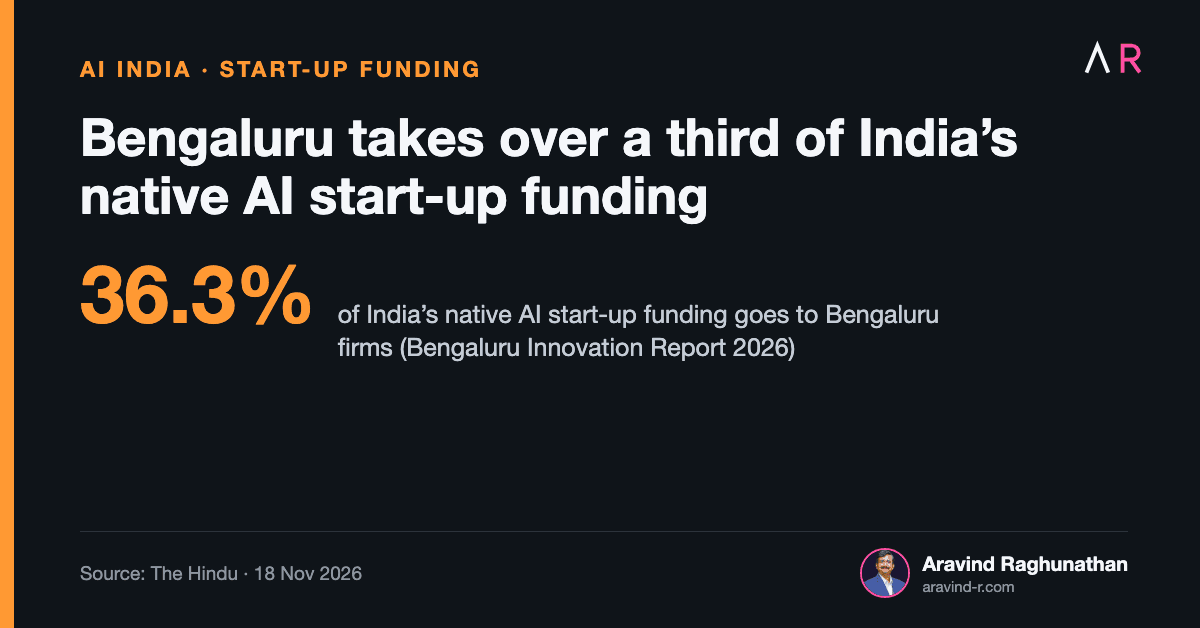
Bengaluru now accounts for 36.3% of all the funding that has gone into India's native AI start-ups. That is the headline number in the Bengaluru Innovation Report 2026, which Karnataka's IT minister Priyank Kharge released on 18 November, on the second day of the Bengaluru Tech Summit.
The report was put together by the Karnataka Digital Economy Mission (KDEM) and 3one4 Capital, using Tracxn data. Some of it is a scorecard and some of it is a pitch, and they're worth reading separately.
The numbers
- City-based start-ups have raised about $85 billion since 2010. That is 47% of all venture money raised by Indian start-ups, and $76.5 billion of it came in the last ten years.
- 71% of India's AI and deep-tech unicorns created since 2023 are in Bengaluru.
- Of 1,556 deep-tech start-ups founded in the city since 2010, 1,319 are active and funded. Together they have raised $3.77 billion.
- The city has 57 unicorns worth a combined $211 billion, which is 55.3% of the value of every Indian unicorn. The report calls it the world's fifth-largest unicorn hub.
- 212 "soonicorns", and 16 Bengaluru-linked listings since November 2024 with a combined listing value of $42 billion.
- Start-ups there reach unicorn status in about six years and a public exit in 8.2 years, against a global exit average of 11.1.
What I'd read into it
The 36.3% figure is the one that matters for anyone building or buying AI in India. A third of native AI funding in one city means the talent, the investors and the early customers sit close together, and that compounding is hard to copy by policy.
Compare the two ratios, though. Bengaluru takes 47% of all start-up funding but only 36.3% of native AI funding. So AI money is already less concentrated than start-up money in general. Close to two-thirds of it is going to founders outside the city.
Karnataka knows this. Kharge's line at the launch was that the next task is making sure a serious AI, quantum or semiconductor company can grow in Kalaburagi, Hubballi or Mangaluru too. The state is backing that with a ₹1,000 crore Local Economy Accelerator Programme, Global Technology Centres in Mysuru, Hubballi and Belagavi, and an ELEVATE grant scheme that has supported 1,479 start-ups across 30 districts.
Two smaller details caught my eye. Nearly 30% of India's active, funded women-led deep-tech and AI start-ups started in Bengaluru. And 52% of Alternative Investment Fund capital now comes from domestic investors. Deep tech needs patient capital, and more of it is now coming from home.
Bear in mind this is a state-sponsored report released at the state's own tech summit, so it is written to attract investors and GCCs. The underlying data is Tracxn's and the ratios are consistent, but read the rankings as a sales document as well as a census.
If you run AI partnerships, hiring or a GCC, check whether your plans assume Bengaluru will stay this dominant. On AI funding, the report's own numbers say the concentration is already loosening.