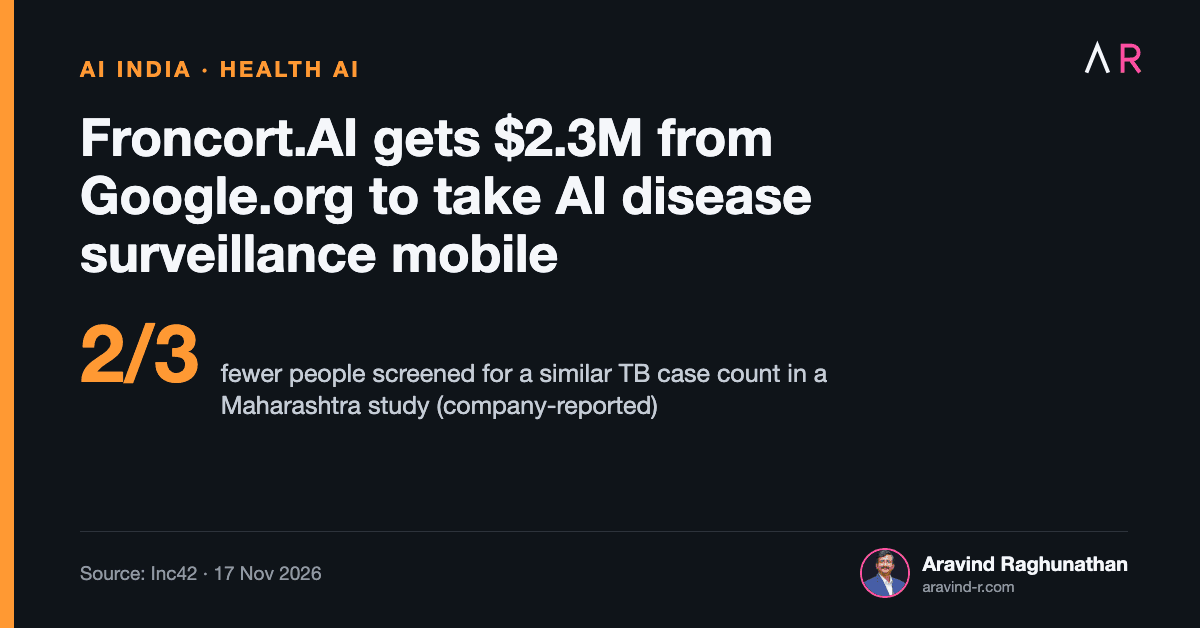
Froncort.AI, a healthcare AI startup founded in 2024 by physician-scientist Dr Ujjwal Rao, has raised $2.3 million (about ₹21.5 crore) from Google.org, Google's philanthropic arm. The package also includes $200,000 in Google Cloud credits and pro bono help from Google's AI specialists.
The startup is one of 15 organisations picked worldwide for Google.org's Impact Challenge: AI for Government Innovation.
What the money builds
Froncort's core product is AI-NETRA, a public health platform that combines government health programme data with Google's Earth AI models and local risk signals such as settlement density, land use, rainfall and flooding. It flags the geographic clusters where people are most likely to catch an infectious disease, then turns that into ranked work plans: which household clusters to visit, in what order, along which route.
The new funding goes into mAI-NETRA, a mobile version meant for the frontline health workers who actually do the screening. Froncort also wants to widen coverage from TB to six infectious diseases: TB, leprosy, malaria, dengue, cholera and leptospirosis. And it plans to release mAI-NETRA as an open-source blueprint that state governments can adopt and adapt.
The Maharashtra TB numbers
In a validation study with Maharashtra's state TB programme, Froncort says teams using AI-NETRA found a similar number of confirmed pulmonary TB cases while screening two-thirds fewer people than conventional methods. Cost per confirmed case fell from about $29,000 to $10,000, and 92% of participating frontline workers reported a lighter workload.
These are company-reported figures from one state programme, so treat them as a promising signal rather than a settled result. Even so, it points in the direction public health systems need: roughly the same detection for much less field effort.
Where it sits
Most AI-in-healthcare stories in India are about diagnosis at the point of care, a model reading an X-ray or a retinal scan. Froncort works one step earlier. It decides where the screening team should go in the first place. That's a resource allocation problem. When frontline workers are stretched thin, better routing may matter as much as better diagnosis.
I'd watch the open-source plan most closely. If any state can adopt the blueprint, a pilot in one state can turn into national infrastructure. That brings the hard questions forward too: who validates the model on new geographies and new diseases, how the risk maps handle data gaps, and who is accountable when a cluster the model ranked low turns out to be the one that mattered.
Inc42 notes that AI funding in India grew 235% year on year in Q3 2026 even as overall startup funding stayed under pressure. Grant money for public systems is a small part of that. It's also the part most likely to reach people who will never use an AI product themselves.
Source: Inc42: Froncort.AI Raises $2.3 Mn From Google.org To Expand AI-Based Disease Surveillance