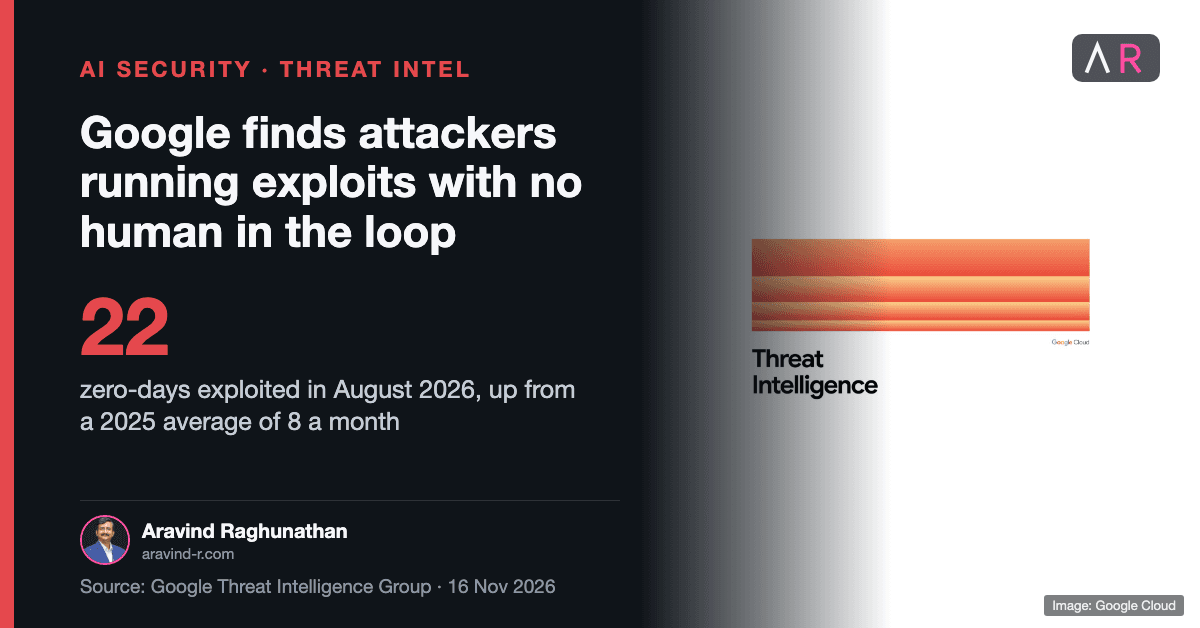
Google Threat Intelligence Group and Mandiant published their latest AI Threat Tracker on 16 November. The headline finding: for the first time, they caught attackers running vulnerability discovery and exploitation end to end with no human in the loop.
The exploit_agent server
GTIG found an exposed staging server hosting a multi-agent framework its operators called exploit_agent. It connects to several frontier and local LLMs and runs continuous differential analysis on popular web application software. It compares code before and after a patch, works out what the patch fixed, drafts an exploit and runs it. The server also held data stolen from victims and post-compromise scripts for reconnaissance and brute-forcing. The configuration comments were in Russian.
Defenders have worried about patch-diffing for years. Now someone has automated it, and the time between a patch going out and an exploit showing up keeps getting shorter.
The numbers behind it
GTIG's September analysis, cited in the report, found that overall vulnerability disclosures and exploits nearly doubled between January and August 2026. Zero-days grew more slowly, from a 2025 average of 8 a month to 11 a month in 2026, then jumped to 22 in August.
Open source attack frameworks are in production
ARTEX got most of the attention this month, but it has company. GTIG names several open source multi-agent offensive frameworks seen in real intrusions or under testing:
- CAIRN, used against targets including the US aerospace sector
- PentAGI, which one actor customised for reconnaissance and scanning across organisations in Asia from late August to early October
- CyberStrikeAI and HexStrike AI, which wire LLMs to more than 100 and 150 offensive tools respectively
Users include financially motivated crews and suspected PRC-nexus espionage groups, one of which was building its own framework.
The weakness defenders can use
GTIG notes that these frameworks currently give up stealth for speed. Unrestricted autonomous execution is noisy. It generates forensic traffic, uses recognisable identifiers and leaves artefacts behind. For now, that noise is the defender's best opening.
What to do this quarter
- Shrink patch windows for internet-facing systems. Assume an n-day becomes a working exploit within days, not weeks.
- Tune detection for volume and velocity patterns, not only signatures. Google has shipped ARTEX rulepacks in SecOps, and Mandiant published a hardening guide.
- Treat LLM API keys and cloud AI credentials as high-value secrets. The report also covers LLMJacking, where stolen model access is resold through underground proxies.
- Review what your coding assistants are allowed to execute. GTIG describes espionage actors tampering with coding-agent configurations to drop backdoors.
Source: GTIG AI Threat Tracker: Agentic Threat Activity Crosses a Significant Threshold (Google Cloud Blog)