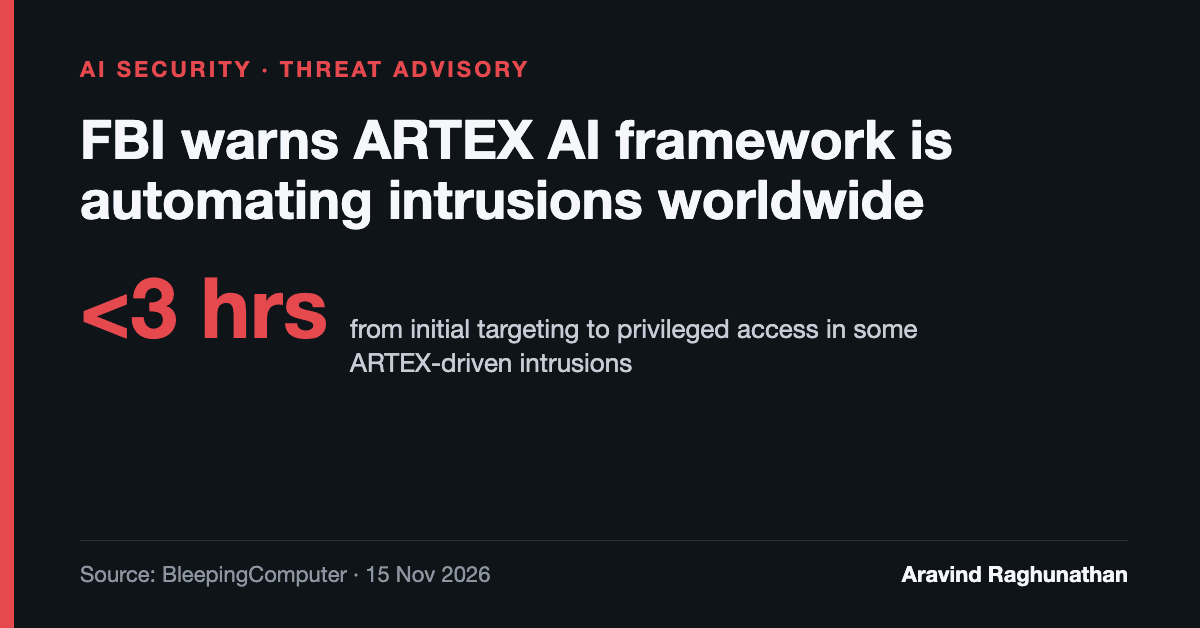
The FBI has issued a FLASH advisory on ARTEX, an open-source, AI-driven penetration testing framework that it says multiple threat actors have turned into an attack tool. According to the bureau, it has been used since at least August 2026 against organisations in finance, government, technology, defence, healthcare and other sectors.
The detail security teams should note: some intrusions went from initial targeting to privileged access in under three hours.
What ARTEX does
ARTEX is written in Go and runs AI agents that handle reconnaissance, vulnerability discovery, exploitation, privilege escalation and data theft with little human input. It doesn't ship its own model. It plugs into external LLMs, including Anthropic Claude, OpenAI GPT, DeepSeek, GLM, Grok and Kimi.
An attacker gives it goals; ARTEX turns those into commands for specialised agents and can work against several organisations at once. The FBI says it is especially good at finding weak spots in systems people forget about: partner portals, employee apps, legacy services and third-party integrations.
The original GitHub release came in July 2026 from a developer called Autumn-27, who pulled the repository on October 8 once abuse reports surfaced. Taking it down didn't stop it. The FBI says forks, archived copies, localised versions and a paid "ARTEX PRO" edition are still circulating, and researchers had counted more than 1,600 publicly exposed ARTEX consoles by early November.
Where it has already shown up
The advisory links ARTEX to several known campaigns:
- ConnectWise Cloud Backup supply-chain attack (October): Microsoft attributed it to China-aligned Storm-0940, which used ARTEX to attempt authentication against more than 2,250 downstream Microsoft 365 tenants. Huntress counted at least 162 compromised tenants.
- South Korean banks: An attacker paired ARTEX with Claude Code agents against Shinhan, KB Kookmin and Hana Bank, exposing data on about 67,000 people.
- A gang in South Korea: Police arrested seven suspects tied to attacks on more than 90 organisations and about 8.2 million stolen records.
- Vapor Panda: CrowdStrike reports the group used ARTEX against more than 200 organisations in 14 countries, compromising at least nine.
What defenders can do
Automated attacks are noisy, which helps defenders, because they throw off a lot of suspicious traffic. They are also fast. If an intrusion can reach privileged access in under three hours, an alert nobody looks at until morning is too late.
The FBI's recommendations are basic: lock down internet-facing applications, restrict access to cloud admin interfaces, review app permissions and authentication logs, rate-limit sensitive APIs, and watch for bursts of automated requests, unexpected credential or privilege changes, and large data transfers. The 13-page advisory includes indicators of compromise, though the FBI warns that IP addresses may already have changed. Researcher MalwareMustDie has also released an open-source ARTEX detection signature pack.
The ConnectWise case also says something about third-party application identities. It worked because attackers abused permissions customers had already granted. It's worth knowing which apps hold standing access to your tenant, and why.
Source: FBI warns ARTEX AI hacking tool is powering global cyberattacks, BleepingComputer