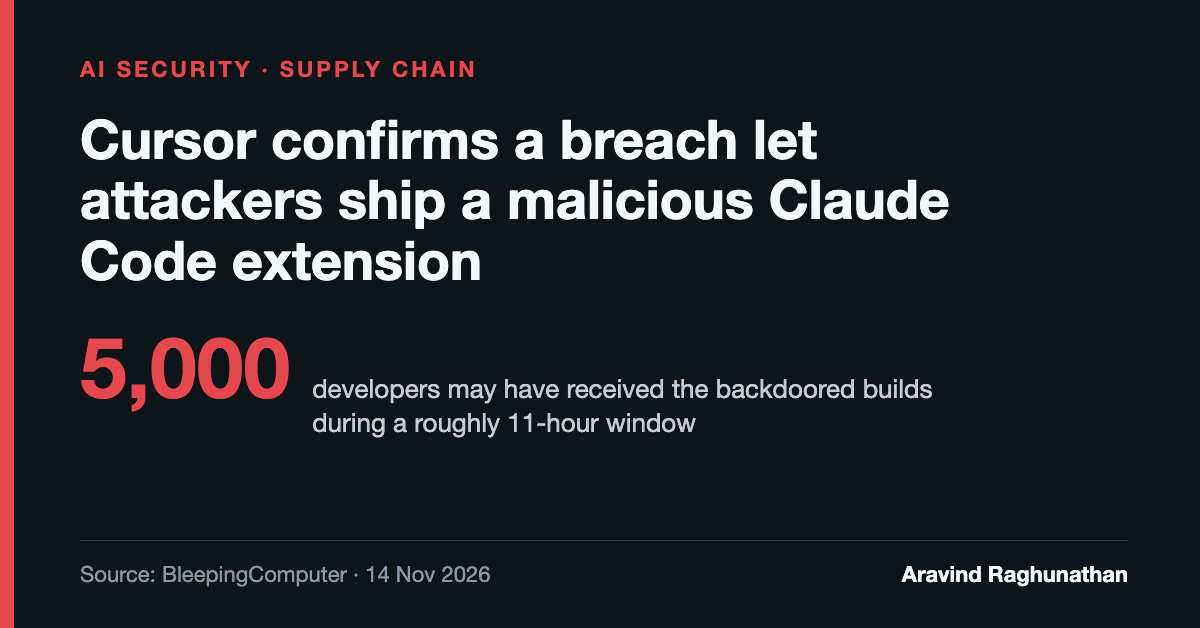
Cursor has confirmed that a security breach let attackers publish malicious copies of Anthropic's Claude Code extension through its own extension marketplace. Up to 5,000 developers may have received the backdoored builds.
The attack didn't begin at Cursor. It began at one of Cursor's suppliers, and that is the part enterprise teams should pay attention to.
How the attack chain worked
- Attackers got an access key stored at Fireworks AI, a third-party provider Cursor used for model training and inference.
- That key opened a read-only storage bucket Cursor used to share data with Fireworks. It held historical AI coding-agent traces, mostly from 2025, from users who had not turned on Privacy Mode. Some traces contained unredacted API credentials.
- Attackers used them to pull data from several of Cursor's SaaS tools: archived non-production source repos, some support emails, usage metrics, customer contact details, summaries of some agent conversations, and credentials customers had shared with support.
- On 29 October the attackers used a stolen credential to place malicious copies of the Claude Code extension, versions 2.1.312 and 2.1.313, on the cache that serves Cursor's VS Code extension marketplace. They stayed up for about 11 hours.
The modified extension tried to install persistent SSH backdoors: it collected system information, added an attacker-controlled SSH key and set up persistence. Researchers found coding errors that probably stopped it working on many Windows and macOS machines where SSH wasn't already enabled.
What wasn't affected
Cursor says Anthropic's real extension and the Open VSX marketplace were not compromised. Production infrastructure, official app releases, customer code repositories, and the code and prompts of Privacy Mode users were also untouched. Fewer than 0.05% of users had agent traces exposed, and fewer than 0.01% had API credentials compromised.
Cursor has moved all inference away from Fireworks, rotated credentials, rebuilt its extension marketplace and redeployed production as a precaution.
Not an isolated case
Wiz has called this run of incidents "Black October" for AI developer platforms. Railway, Northflank, Lightning AI, OpenCode and Warp were all hit, and Fireworks itself disclosed more than one breach, which also exposed some Notion AI chat transcripts. At Railway, stolen secrets led to about $740,000 in fraudulent AI charges.
What enterprise AI teams should take from it
- Coding-agent logs hold secrets. Traces capture whatever a developer pastes or a tool prints, keys included, so redact at capture, keep them for less time and limit who can read them.
- Your AI vendor's suppliers are part of your risk. This breach came through an inference provider most Cursor users had never heard of, and vendor reviews rarely look that far down.
- Extension marketplaces are a software supply chain. Pin versions, restrict which extensions developers can install, and check developer machines for unexpected SSH keys or services.
- Privacy settings changed who was exposed. Users with Privacy Mode on weren't affected, which is a good argument for enforcing data-minimisation defaults centrally instead of leaving them to each developer.
If anyone on your team installed or updated the Claude Code extension in Cursor around 29 October, follow Cursor's remediation guidance now.
Source: BleepingComputer: Cursor confirms security breach led to malicious Claude Code extension