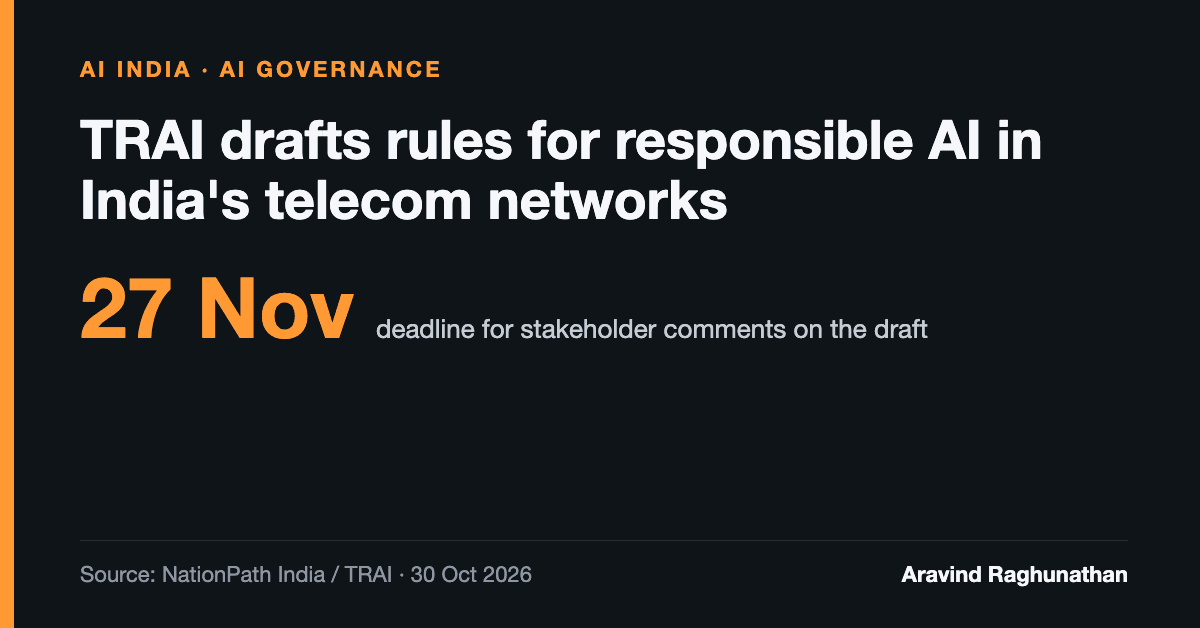
India's telecom regulator wants AI in the network to come with a paper trail. The Telecom Regulatory Authority of India (TRAI) released draft Guidelines on Responsible Use of Artificial Intelligence in Telecommunication Networks and Provision of Telecommunication Services on 30 October 2026, and stakeholders have until 27 November to comment.
This is a consultation draft, not a final rule. But it is the first time a sector regulator has tried to turn India's broad AI governance principles into concrete obligations for one industry, so the details matter.
What the draft asks telecom operators to do
A board-approved AI policy. Every applicable authorised entity would need an internal AI policy signed off by its board or equivalent governing body. That moves AI from an engineering call to a board-level one.
Risk classification. AI systems would be sorted into high, medium and low risk, based on how significant they are to telecom operations, what financial and operational outcomes they touch, and what they mean for consumers.
Named approvers. An AI system would go live only after approval by designated officers inside the organisation, with approval authority mapped to the risk tier.
An incident register. Operators would keep a central database of AI-related incidents, graded by severity. Critical and high-severity incidents would have to be reported to TRAI in a prescribed format and timeframe.
Human oversight and data governance. AI used in networks and services would need appropriate supervision, and data used or generated across the AI lifecycle would have to be handled under existing privacy, confidentiality and cybersecurity requirements.
A grievance route for users. Telecom customers harmed by an AI system would get a redressal mechanism with a reasonable resolution timeframe.
An AI Governance and Safety Committee. This internal body would review AI performance, incident records, vulnerabilities and emerging risks.
Why telecom first matters
Telecom networks carry payments, emergency calls and a lot of national-security traffic. Operators already use AI for network optimisation, predictive maintenance and customer support, and the draft names the failure modes it worries about: biased outputs, unexpected behaviour, model drift and adversarial attacks.
The structure is the useful part. Board-approved policy, risk tiers, named approvers, an incident register and a safety committee is close to what large enterprises outside telecom are building for themselves right now, often without a regulator telling them to. If TRAI finalises something like this, expect banking, insurance and healthcare regulators to borrow the structure.
I expect the incident register to be the sticking point. Defining what counts as an "AI incident", and what makes one "critical", is where most enterprise AI governance programmes stall. The consultation is the moment for operators and vendors to push for definitions they can actually run.
What happens next
Written comments are open until 27 November 2026. After that, TRAI decides whether to revise, finalise or otherwise proceed. Any implementation timeline depends on that decision.
Source: NationPath India: TRAI Proposes AI Governance Rules for Telecom Networks