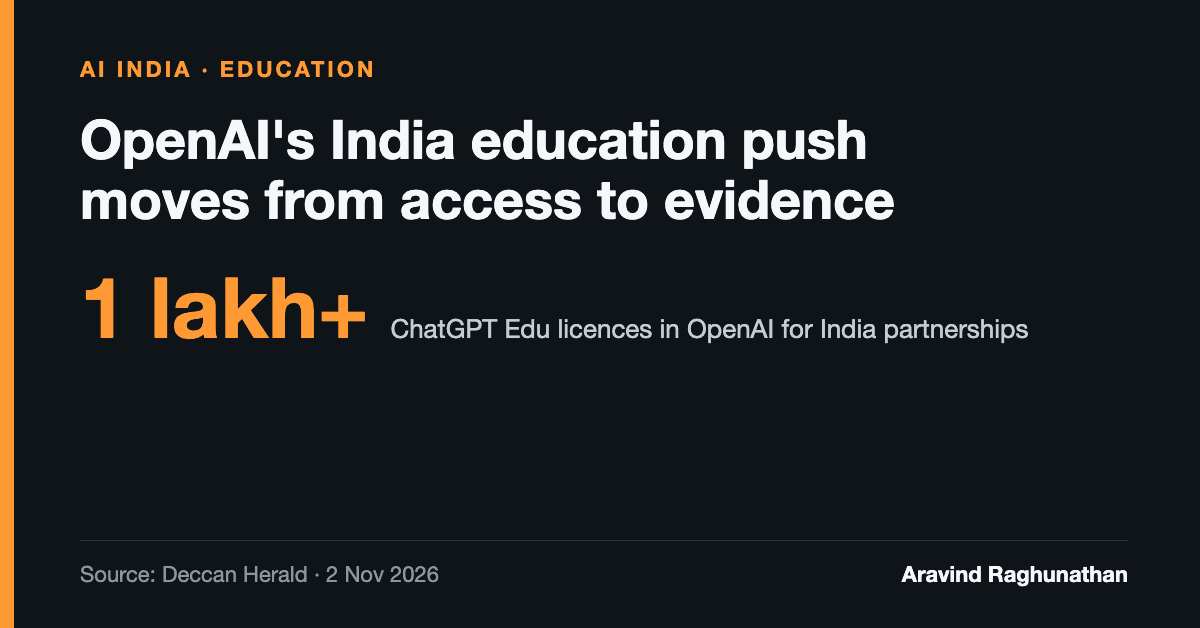
OpenAI says its work in India is moving from access to capability. The next phase, in the words of Raghav Gupta, its Head of Education for India and Asia Pacific, is "about evidence and implementation."
In an interview with Deccan Herald, Gupta set out what OpenAI for India has put in place for education so far, and where it wants to go next.
What is already on the table
- Education partnerships covering more than 1 lakh ChatGPT Edu licences.
- Plans to expand OpenAI Certifications for workforce skilling.
- Study Mode, education-specific workspaces, teacher training, research partnerships and practical skilling programmes.
None of that is new. What's more useful is how Gupta says it should be judged.
The equity test
Gupta's argument is that AI in Indian classrooms succeeds or fails on whether it narrows gaps or widens them. If only already-advantaged students get good AI support, the gap grows. Deployed responsibly, it can reach learners who don't otherwise get high-quality help.
He also widened what counts as the digital divide. It isn't only internet access. It's language, devices, affordability, how prepared teachers are, and how much capacity an institution has to run any of this.
Different roles at different stages
- Schools: age-appropriate and teacher-guided, helping students build understanding rather than skip it.
- Universities: support for research, coding, data analysis, writing and project work.
- Workplaces: part of continuous learning.
Assessment has to change
Asked about students using ChatGPT to shortcut assignments, Gupta put the onus on assessment. Grading needs to make the learning process visible, not just the polished final answer.
He also said institutions need clear rules on what information can be entered into AI tools, what should never be shared, and what protections younger learners need. Students should be taught that AI makes mistakes, can reflect bias and can miss context, and that checking claims against other sources is part of using it.
My read
The 1 lakh licence figure is a distribution number, not an outcome. Gupta seems to know that, which is why "evidence" is the word he leads with. The question for Indian universities and state education departments is whether they will collect that evidence themselves, with their own baselines, or take a vendor's word for what improved. The assessment point is the one I'd act on first. If exams still reward only the final answer, AI will mostly be used to produce final answers.
Source: Can AI bridge India's education gap? OpenAI's Raghav Gupta outlines next big push, Deccan Herald