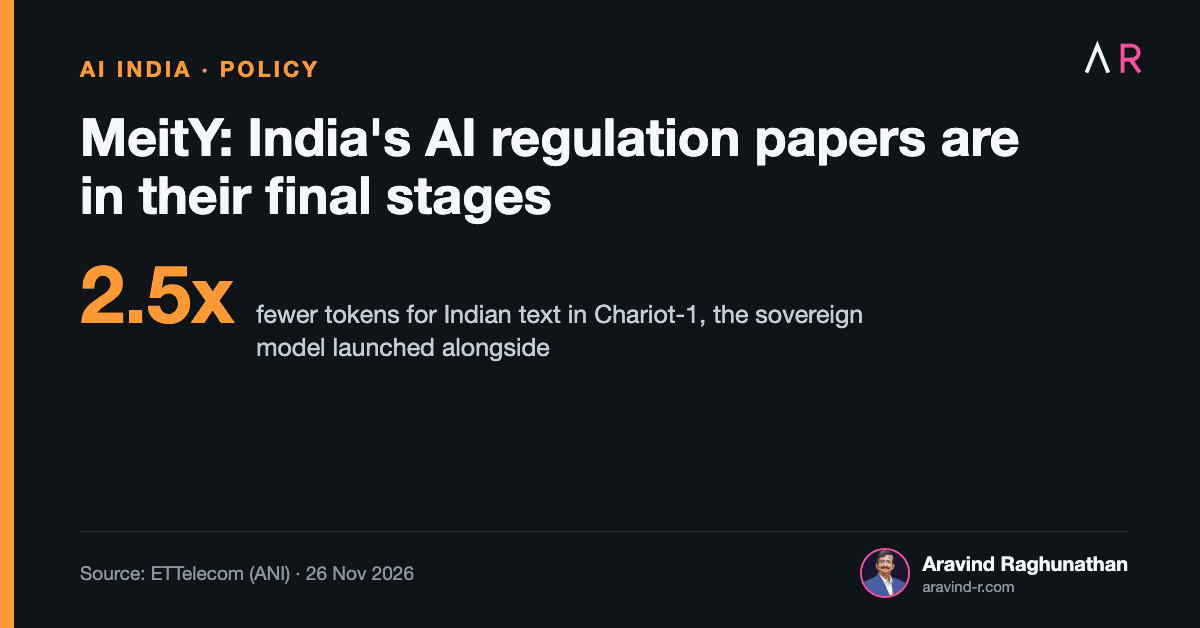
India's AI regulation papers are almost ready. That's the word from S Krishnan, Secretary at the Ministry of Electronics and IT, who said on the sidelines of a model launch that the documents are "in the final stages" and will be out shortly.
He gave no date and said nothing about what the papers contain. Even so, anyone building on AI in India has been waiting to see where the government lands on oversight, and this is the first sign the wait is nearly over.
The launch he was there for
Krishnan was speaking at the launch of Chariot-1, a family of foundation models built from scratch in India by Chariot Artificial Intelligence Pvt Ltd. The company was one of the first four teams selected under the IndiaAI Mission to build sovereign foundation models.
Chariot-1 covers English and 10 Indian languages. Its main design choice: put text generation, text-to-speech and speech recognition in one architecture rather than three separate models. Co-founder Parth Sarthi's pitch is one model doing twenty jobs instead of twenty separate models.
The numbers worth noting
According to the IndiaAI Mission, Chariot-1 makes a few specific technical bets:
- IndicShift, a shared alphabet for Indian scripts, which lets the model process Indian text with 2.5 times fewer tokens.
- Nested Training, which produces three model sizes from one training run and cuts training time by 62%.
- Mixture of Vocabularies, which the mission says delivers 38% faster training.
- Over 97% verbalisation accuracy on the Async Text-to-Speech Pronunciation Benchmark.
The token figure is the one I'd watch. Indian scripts have long been expensive to process in models built mainly around English tokenisers. If a shared alphabet really cuts token counts by 2.5x, running Indian-language voice and text apps on it should get noticeably cheaper, and cost per call is where most deployments feel the pinch.
Sarthi also credited the IndiaAI Mission with providing GPU access and infrastructure. That side of the sovereign AI programme gets far less attention than the models do.
Why the two stories belong together
India is building its own models and writing its own rules at about the same time, and Krishnan spoke to both in one appearance. If you run AI programmes here, it's worth sketching now where your use cases would sit under a light-touch regime and under a stricter one. Then the papers won't catch you out when they arrive.
Source: ETTelecom (ANI): AI regulation papers in final stages, to be released shortly