India's AI startups raised more money in the first nine months of 2026 than in any comparable stretch since 2019. They also closed far fewer deals. Both figures are from Tracxn's India AI 9M 2026 report. The second tells you more.
The numbers
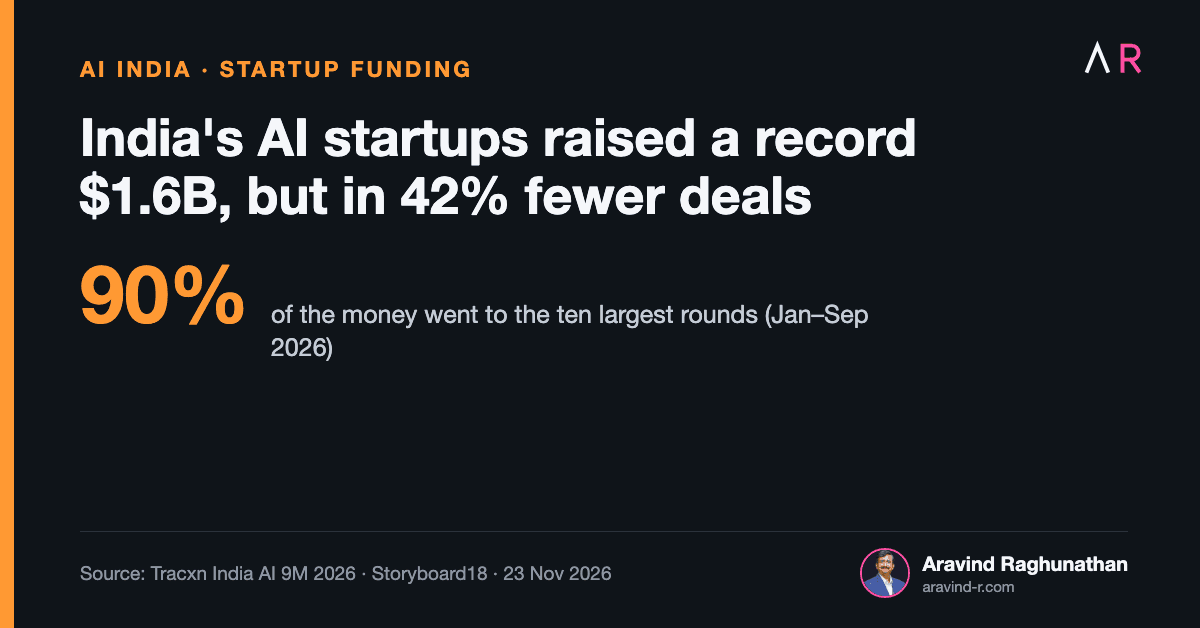
Indian AI companies raised $1.6 billion in equity between January and September 2026, up 96% from $822 million in the same period of 2025. The number of rounds fell 42%, from 149 to 87. The average round grew from $5.5 million to $18.5 million.
The gap is about concentration. The ten largest rounds took $1.5 billion, about 90% of everything raised. Neysa's $600 million Series B in February alone was 37% of the total, and roughly three-quarters of the year-on-year increase.
Other large rounds included Sarvam's $255 million Series B and a follow-on $90.4 million, Yotta's $150 million Series D, Emergent's $130 million Series C and $70 million Series B, and Freehand's $75 million Series B.
Fewer new companies
Under the headline, the pipeline is getting thinner:
- Seed funding fell 42% to $69.2 million, and seed rounds dropped from 113 to 63.
- First-time funded companies fell 60%, from 60 to 24.
- Active investors fell 34% to 111, and international investor participation fell 38%.
Early-stage capital rose 191% to $1.3 billion, but it went into only 21 rounds, at an average of $60.2 million each. Those are late-stage cheque sizes.
Mumbai moves to the top
Mumbai-based companies raised $765 million, 48% of the total, up from $15.7 million a year earlier. Bengaluru came second with $711 million. Chennai was third with $75.5 million, almost all of it Freehand's round. The three cities took 96% of the capital.
What it means
At first glance this is a boom. Look closer and it is a market that has backed a few companies in compute, cloud and foundation models and grown far more cautious about the rest. India's $1.6 billion was 0.4% of the $383.5 billion invested in AI worldwide over the same months, ninth among countries.
This matters to enterprise buyers. The companies most likely to still be around in three years are the well-capitalised infrastructure and model players. The long tail of application startups that would normally serve niche enterprise needs is getting less funding, and fewer new ones are being founded. When you shortlist an AI vendor, ask how much runway it has, not only what the product does.
Source: India AI funding hits $1.6 billion in 9 months 2026, up 96% YoY, Storyboard18