India's Competition Regulator Puts AI on Notice
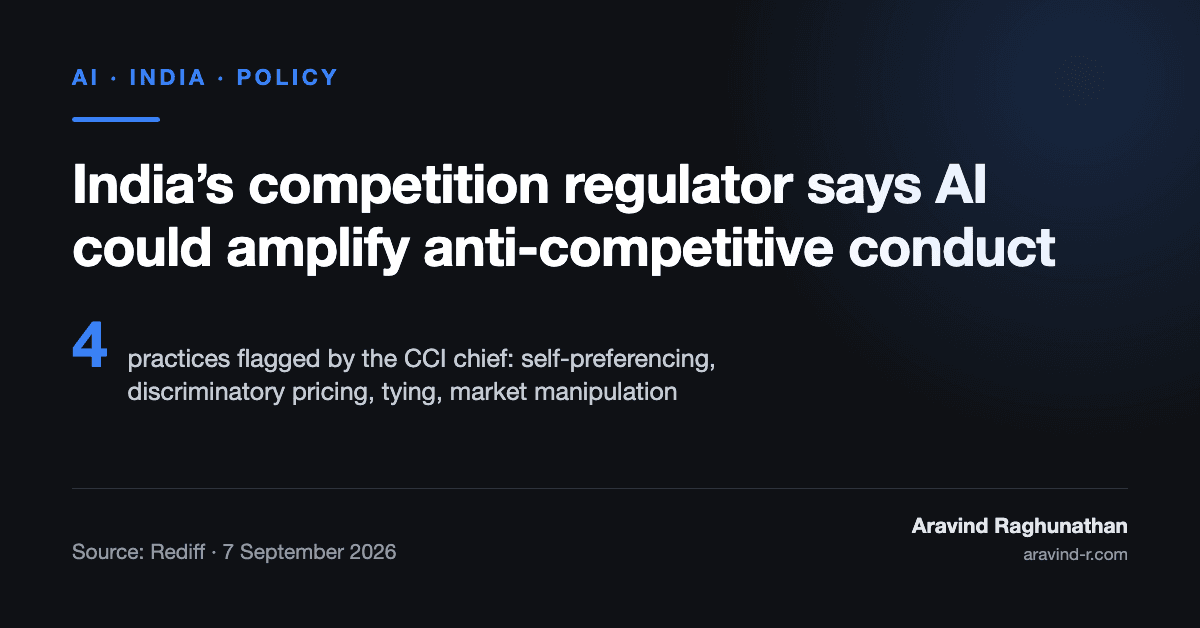
CCI chairperson Ravneet Kaur says AI could amplify self-preferencing, discriminatory pricing, tying and market manipulation — with agentic systems doing it without a human in the loop.
Competition Commission of India chairperson Ravneet Kaur used a law-school workshop in Goa on Monday to say something India's enterprise AI conversation has mostly stepped around: the tools everyone is deploying for efficiency can break competition law without anyone deciding to break it.
Her phrasing was blunt. Digital markets were already moving fast, she said, and AI has turned that into "jet speed."
What the regulator is watching
Kaur named four practices AI could amplify: self-preferencing, discriminatory pricing, tying, and market manipulation. None are new — the CCI has pursued all four in digital-market cases. What is new is the mechanism.
The concern she flagged hardest is agentic AI acting with no human in the loop. Her example was pricing. An algorithm watches a competitor's prices and automatically matches or undercuts them. No meeting, no email, no agreement between the firms — the two systems just learn to move together. From outside it looks like collusion. Inside, there are no colluders.
"The algorithms are made in such a way that it is something happening on its own," she said.
Studying, not ruling
Kaur was equally clear the commission does not plan to step in every time a new technology shows up. The CCI ran a first-of-its-kind study on AI and competition last year, and she argued market studies are the right instrument while a market is still forming — particularly given the size of India's startup ecosystem.
That is a choice, not a delay. Study first, rule later, don't freeze a market nobody understands yet.
If you are the one deploying
Dynamic pricing is the obvious exposure. If your model reacts to competitors' prices in real time, "no human chose this" is not a defence — that is precisely the conduct she said the CCI is examining.
Ranking and recommendation systems are the quieter one. Self-preferencing is on her list, and a ranker trained on your own commercial objectives can produce it without anyone writing it down as a rule.
The fix isn't to slow the deployment down. It is to be able to reconstruct, months later, what the system did and why: logs, decision traces, and a named human who owns the model's behaviour. That is the difference between explaining an outcome and shrugging at it.
India's competition regulator has now said publicly that it is looking. Keeping that record is cheaper before the question arrives than after.
Source: AI may accelerate anti-competitive practices: CCI chief — Rediff