India Builds Two of the World's 257 AI Models. It Runs on the Rest.
Of the 257 AI models on sale globally, two were built in India. Benchmark data shows India's best sitting where the frontier stood two years ago, and 94% of Indian traffic going to US and Chinese models.
There are 257 AI models a developer anywhere in the world can buy access to this month. Two of them were built in India, and both come from the same Bengaluru company.
That figure comes from Artificial Analysis, a benchmarking firm that has now run 610 models through the same nine-test suite. India's entrant is Sarvam. Everything else in Indian production — the bank chatbot, the homework app, the customer service layer — is answered by a machine built somewhere else.
The number that stings
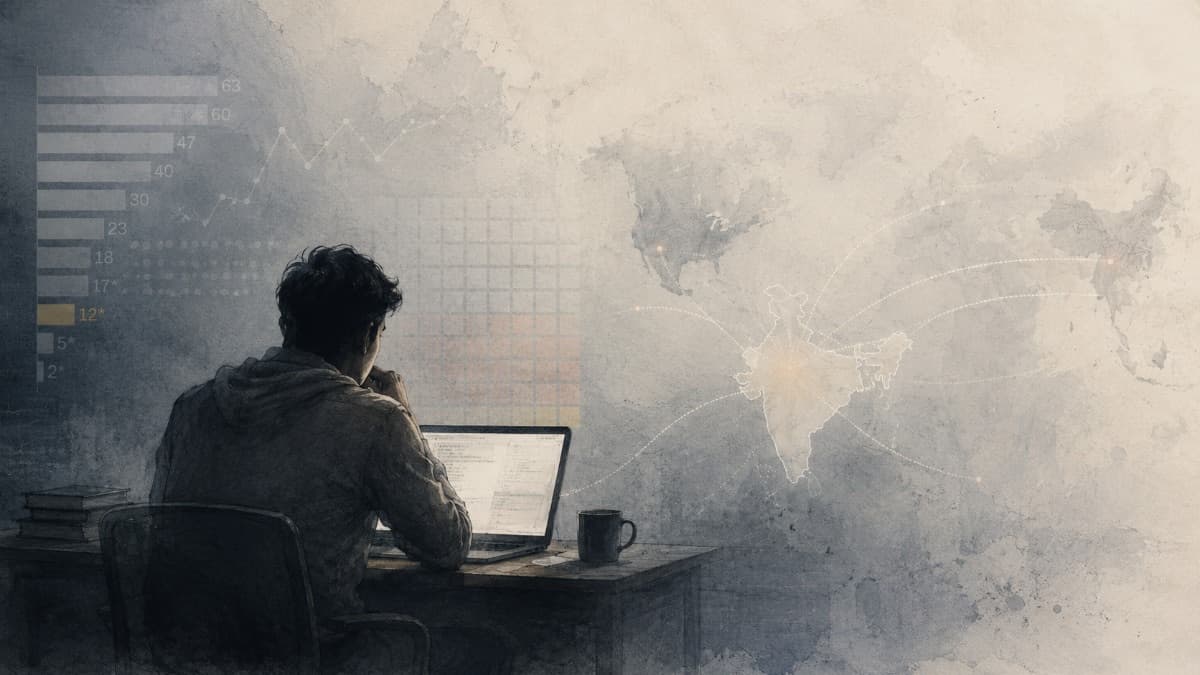
India's best model, Sarvam 105B, scores 11.9 out of 100 on that scoreboard as of 20 August 2026. Anthropic's Claude Opus 5 scores 63.1. China's strongest, Kimi K3, scores 59.7.
Line countries up by their best model and India lands ninth out of the eleven that have shipped anything at all — behind South Korea, Singapore, France, Canada, Spain and the UAE.
One caveat. Artificial Analysis marks both Sarvam scores as estimates rather than complete test runs, which it does when a model hasn't been through the whole suite. The ordering holds regardless.
Two years, not two points
Points out of 100 are hard to feel. Time isn't. The first model ever to clear 11.9 was o1-preview, released in September 2024. India's best today sits roughly where the global frontier sat two years ago, and 171 of the 257 models currently on sale score above it.
The gap isn't closing because India is barely in the race. Since January, the US has shipped 113 new models and China 91. India has shipped two.
It isn't only the frontier that's ahead. OpenAI's freely downloadable gpt-oss-120b scores 24.1 — more than double Sarvam 105B.
What India got right
Sarvam is close to the cheapest thing on the board. Work that costs $10 through Claude Opus 5 runs about seven cents on Sarvam 105B, roughly a 135th of the price. Sarvam also gives its models away to download and run, which neither OpenAI nor Anthropic does with their strongest systems.
That combination — cheap and open — is precisely the lane China took. Chinese labs went that way and in June overtook American models on OpenRouter. More than 60 per cent of the traffic routed through the service last month went to Chinese models.
Nine trillion tokens, mostly foreign
India pushed nine trillion tokens through OpenRouter between January and July, making it the tenth-largest market in the world. Fifty-one per cent went to American models, 43 per cent to Chinese ones. The remaining six per cent covers every other country on earth, India's two models included.
Nobody measured that six per cent as an Indian share. It is what was left after the two big blocs were counted. It is also the closest thing anyone has to a figure for how much of India's AI work runs on Indian AI.
The test nobody sets in Tamil
The nine benchmarks measure coding, scientific reasoning, general knowledge and autonomous operation. Not one of them touches an Indian language. Nothing in the score says whether a model can handle a complaint in Bhojpuri, read a Marathi land record, or answer a pension query in Tamil.
That is the problem Sarvam exists to solve, and it's the one a global leaderboard structurally cannot judge.
The counter-argument
Nandan Nilekani made the opposite case at the NCAER India Policy Forum in Delhi on 6 August: infrastructure gets commoditised, value moves to the application layer, and India should aim to be the world's AI use-case capital rather than chase the frontier.
The usage data backs him up. Stanford's AI Index found 58 per cent of employees worldwide used AI at work regularly in 2025 — but in India, China, Nigeria, the UAE, Egypt and Saudi Arabia the share cleared 80 per cent.
The same report found India registered the sharpest rise in AI concern of any country surveyed between 2024 and 2025, up 14 percentage points against two points of additional excitement. Being the use-case capital also means being maximally exposed to decisions made in San Francisco and Hangzhou.
The part that isn't technical
Supreme Court lawyer Dr Sanjay Sharma framed the real question for India Today: as AI starts mediating banking, education, courts and public services, dependence on foreign models stops being a technology or trade matter and becomes one of accountability, geopolitical risk and institutional sovereignty.
No benchmark shows that gap. A scoreboard can tell you how well a model writes code. It cannot tell you who answers for the decision when a model inside a bank, a school or a courtroom gets one wrong.
Source: India Today — The cheapest AI in the world is Indian. It is also the weakest