Coding Agents Moved Science's Software Bottleneck
OpenAI's field report on eight agent-assisted research projects finds engineering labour is no longer the constraint in scientific computing — verifying the agent's output is.
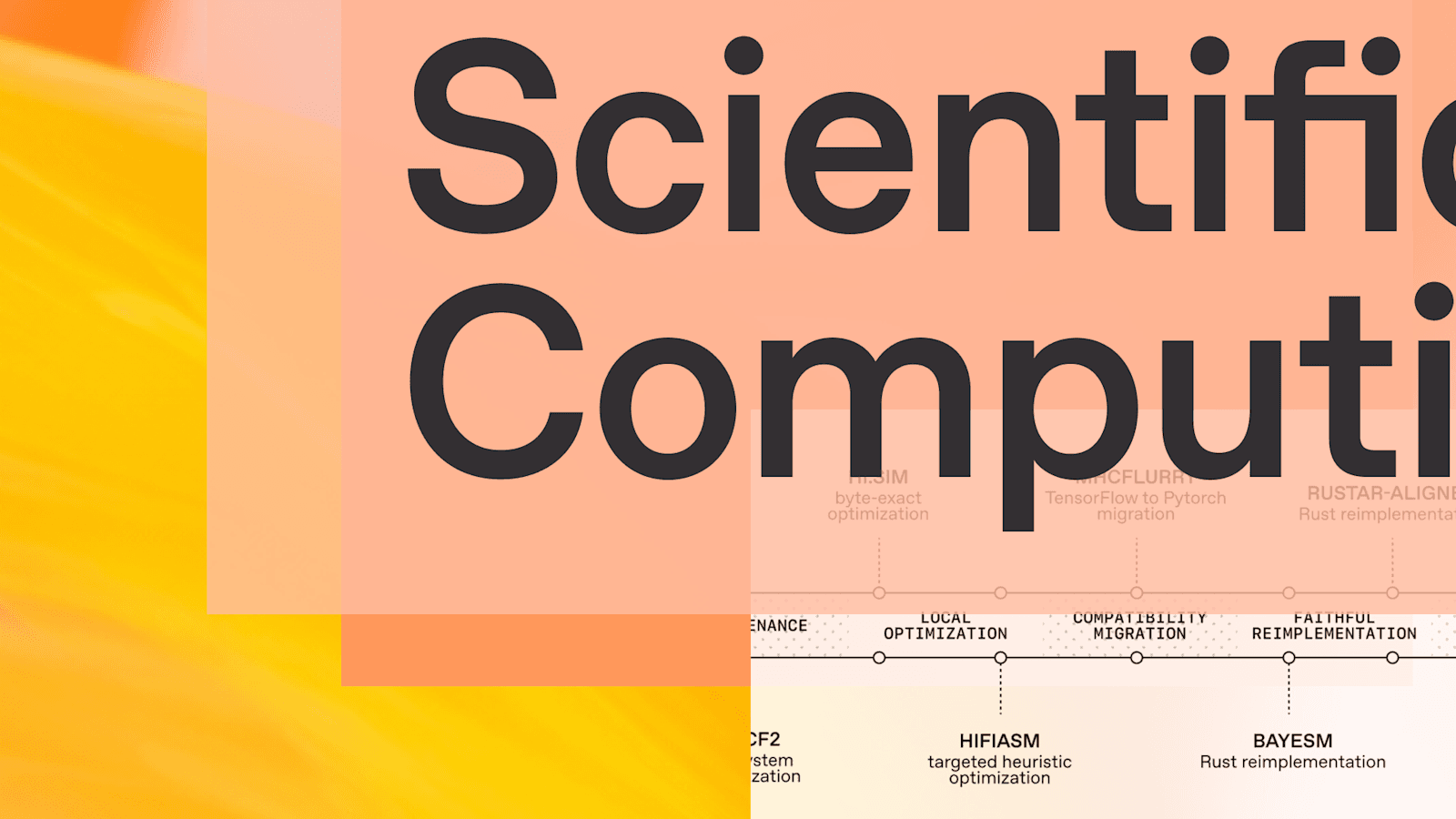
Eight projects, one field report
OpenAI published a field report on 28 July 2026 covering eight agent-assisted scientific computing projects, mostly in the life sciences. Five used Codex on its own; three paired Codex with Claude Code. The projects were cyvcf2, HI.SIM, hifiasm, MHCflurry, bayesm-rs, Rustar-aligner/svb/kuva, RustQC/FastQC-Rust/Trim Galore, and HelixForge. Scope ran from routine maintenance and targeted optimization up to full language migrations and GPU-native redesigns.
How the software got this way
Plenty of widely used research tools began life as code attached to a paper — small academic teams, limited engineering experience, no time budgeted for packaging, testing, optimization or long-term support. Published studies of research code and omics tools have turned up software that won't install cleanly on a fresh setup or won't run as documented. Researchers then burn their own time on configuration and debugging instead of the science.
The bottleneck moved
Engineering labour is less of a constraint now. Verification took its place.
Agents handled specific, well-scoped requests well, but they could not tell whether their own output was scientifically valid — and they often sounded confident while being clearly wrong. What worked for reviewers was an external reference or a measurable acceptance target: exact output agreement, parity with an existing tool, statistical behaviour in the expected range, or answers pinned down in advance using simulated data.
Staged, not one-shot
None of these ran as a single prompt-to-finished-tool jump. Contributors split broad goals into smaller changes and checked each one against intermediate benchmarks and test systems. First implementations arrived fast. Edge cases and small numerical discrepancies took much longer. The last mile ate the most time.
As Brent Pedersen put it, with coding agents "it's quite easy to go fast" — going far still takes expert judgement.
Who owns the rewrite afterwards
Cheap rewrites have a downside: it becomes easy to produce many near-identical versions of the same tool, splitting the userbase and thinning out the expert attention any one of them gets. Mature scientific software also carries undocumented conventions, compatibility requirements and user trust that translating the source alone won't reproduce.
The report shows a few workable paths. MHCflurry and cyvcf2 changes went upstream into the original projects. Rustar-aligner moved under new community stewardship because the original had been abandoned. Where the existing maintainers are reachable, talk to them early. Where a separate implementation is genuinely needed, it needs a named owner and a real maintenance plan — otherwise today's modern rewrite is next year's dead repo.
Source: OpenAI