For two years, India's sovereign AI debate has mostly been about whether we can build our own foundation models. At the ET Vision Conclave 5.0, BharatGen founding director Ganesh Ramakrishnan talked about the next problem: getting those models to work inside government offices, hospitals and insurers.
The problem he started with
"Global AI is built for a fraction of the world," Ramakrishnan said. He pointed to three gaps: representation, compliance and access.
Most AI systems are built mainly for English and stumble on Indian languages, documents and cultural context. In BFSI, healthcare and government, sensitive data has to stay inside controlled infrastructure, which rules out a lot of hosted options. Depending on foreign providers leaves pricing and availability exposed to someone else's commercial decisions.
What BharatGen has built
BharatGen is a government-funded initiative run by an academic consortium of nine institutions led by IIT Bombay. Its model suite covers text, speech and documents.
- Param, its LLM series, supports 22 Indian languages and English. BharatGen says it was pretrained from scratch on Indian-language data, not retrofitted through translation or light fine-tuning. It uses a mixture-of-experts design: 17 billion parameters in total, with 2.4 billion active per token, to keep inference costs down.
- Shrutam handles real-time speech-to-text across Indian languages, including code-mixed speech.
- Sooktam does text-to-speech, with cross-lingual generation and voice cloning.
- Patram is a vision-language model for Indian documents: government orders, land records, insurance policies, bank statements, medical reports and court filings, complete with mixed scripts, handwritten notes and stamps.
The training corpus is over 22 trillion tokens, 10 trillion of them in Indian languages. Over two years the initiative says it has released more than seven model versions, published 20+ datasets and 30+ papers, and passed 180,000 downloads across Hugging Face and AIKosh.
Where it is already running
Param2 powers MahaSamvaad, linked to the Maharashtra government, and InsureCopilot. Other deployments include clinical documentation for Amrita Hospitals, a teacher-assisted learning platform with Kotak Education Foundation, and an assistant for IGNOU.
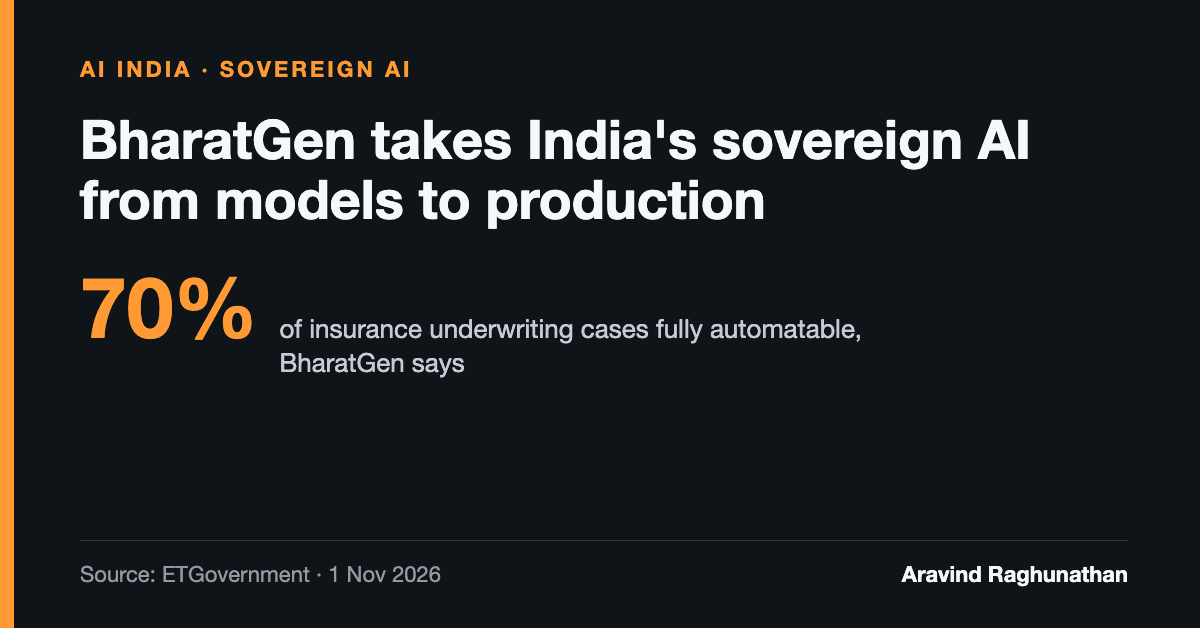
The insurance work has the most concrete numbers. BharatGen's underwriting assistant extracts, compares and flags deviations across medical, pathology and identity documents. The presentation claims it cuts case reviews from hours to under five minutes, with 70% of cases fully automatable. A separate policy-explainer will answer policyholders in 22 languages over WhatsApp.
Those figures come from BharatGen's own presentation. Nobody has benchmarked them independently yet.
Voice as infrastructure
Ramakrishnan spent time on voice. India's digital public infrastructure was built for screens and text. That shuts out people who would rather speak in their own language than type in English. "For government services to genuinely reach citizens, voice cannot be an add-on," he said.
What comes next
The roadmap includes a 128,000-token context window for Param2, larger models with stronger reasoning and coding, Shrutam and Sooktam across all 22 scheduled languages, and conversational speech-to-speech for Hindi and English. APIs and hosted inference are also planned, which means companies could use the models without running their own servers. For most enterprises, that is the part to watch.
Why it matters for enterprise AI
For a bank or insurer in India, the case for a domestic model has little to do with national pride. The questions are practical. Can the model read your documents? Does it understand how your customers talk? Does your data stay where the regulator wants it? If hosted BharatGen APIs arrive with the document and voice capability described here, Indian enterprises get a credible option for regulated, multilingual work, which is where global models struggle most.
I'd still want to know whether 2.4 billion active parameters holds up on the hard cases. Only production use will answer that.