India has spent the last two years talking about AI data centres mostly in terms of land, power and who will lease the capacity. The hardware inside those buildings has largely been imported. A deal signed this week is an attempt to change that.
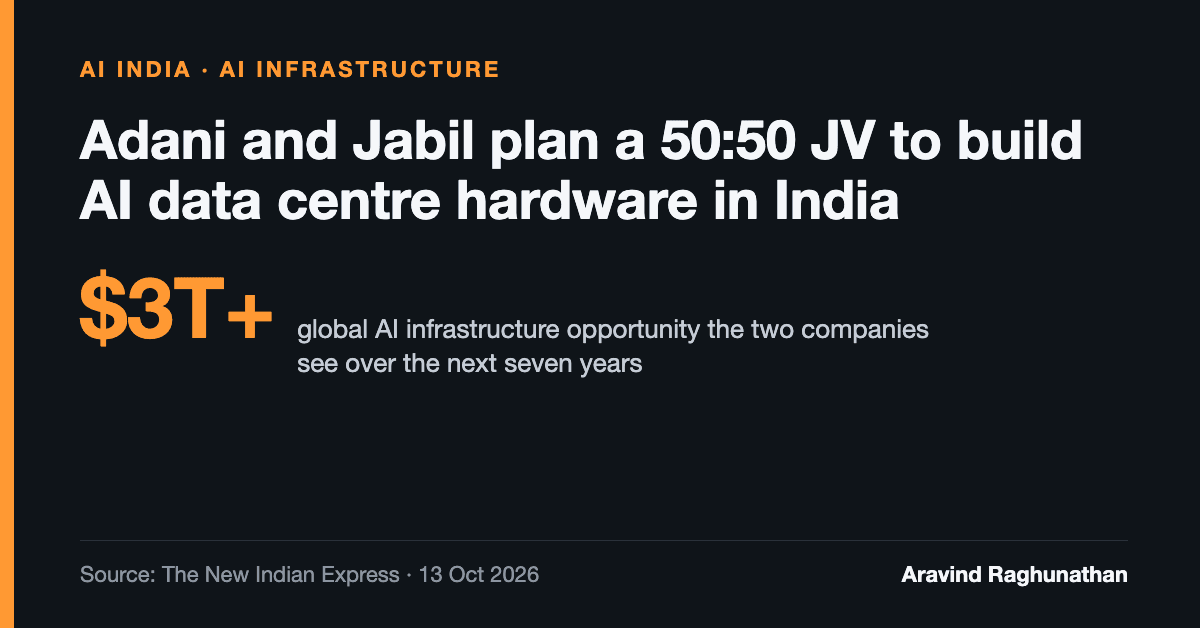
Adani Enterprises and US contract manufacturer Jabil have signed a non-binding memorandum of understanding to set up a 50:50 joint venture that would manufacture and assemble AI and data centre equipment in India.
What the venture would make
The list is broader than servers. According to the companies' release, the JV would build:
- AI racks, servers, storage and networking equipment
- Power distribution units and transformers
- Liquid-cooling systems for high-performance computing
It is expected to have multi-gigawatt AI rack manufacturing capacity, and it would also handle installation and commissioning. Jabil CEO Mike Dastoor described the target customers as large technology companies in India and overseas, so this is pitched at exports as well as domestic demand.
Why the timing makes sense
The numbers in the announcement explain the appetite. India's data centre capacity is projected to reach 5 to 8 GW by 2030, pushed by AI adoption, cloud growth and data localisation rules. The two companies put the global AI infrastructure opportunity at more than $3 trillion over the next seven years.
Adani already has a stated plan to invest $100 billion in 5 GW of green-powered, AI-ready hyperscale data centres by 2035. Until now its role has been energy, infrastructure and hosting. This venture would add the hardware layer. Jabil brings the manufacturing depth, along with recent acquisitions in critical power (Hanley Energy Group) and liquid cooling (Mikros Technologies). It reported $36 billion in revenue for fiscal 2026.
The MoU builds on a strategic alliance the two announced in June 2026.
What to keep in mind
This is an MoU, not a factory. It is non-binding and still subject to definitive agreements, regulatory approvals and the usual conditions. No investment figure, location or production date has been disclosed.
Still, the direction matters. Liquid cooling and power distribution are where AI data centre builds get stuck, and they are the parts least likely to be made locally today. If the JV does reach multi-gigawatt rack capacity, Indian operators would have a domestic option for the equipment that currently sits on long import lead times. For enterprises planning private AI infrastructure, that is worth watching more closely than another capacity announcement.
Source: The New Indian Express, Adani, Jabil sign MoU for 50:50 JV to manufacture AI data centre equipment