The World Bank's AI Jobs Numbers, and What They Don't Say About India
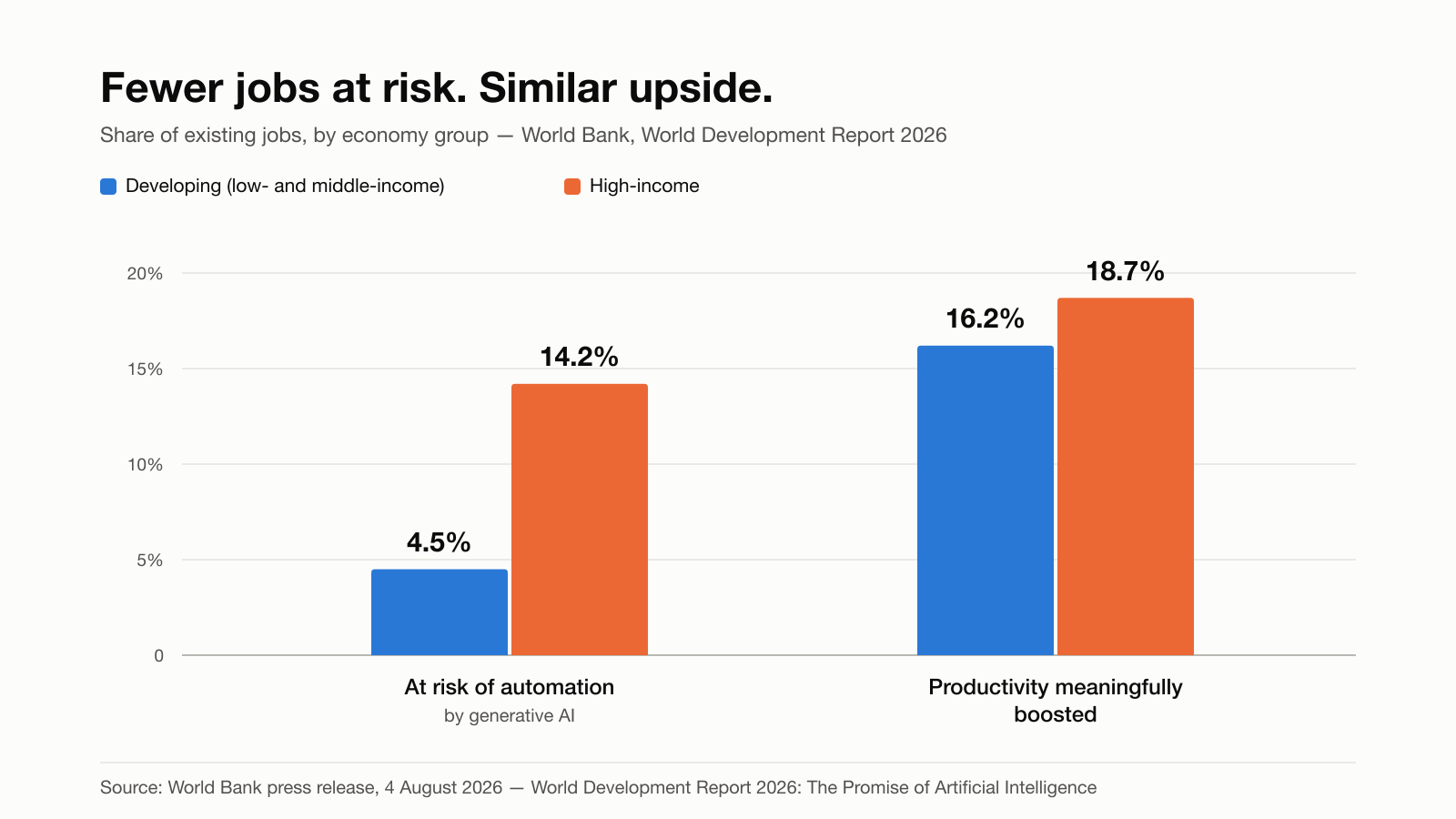
The World Development Report 2026 finds 4.5% of jobs in developing economies exposed to AI automation against 14.2% in rich ones — with nearly identical productivity upside. The India question is separate.
The headline numbers
The World Bank released World Development Report 2026: The Promise of Artificial Intelligence on 4 August 2026. Two figures carry the argument.
Exposure to automation. 4.5% of existing jobs in low- and middle-income countries are at risk from generative AI, against 14.2% in high-income countries — roughly three times the exposure in rich economies.
Exposure to improvement. 16.2% of jobs in developing economies could see meaningful productivity gains, close to the 18.7% expected in high-income countries.
That combination is the whole finding. Much less downside, nearly the same upside.
Why the gap exists
The mechanism is unglamorous: most people in developing countries do manual rather than cognitive work. Generative AI automates cognition. So in the report's framing, the immediate effect of adoption there is to "complement rather than displace workers".
The gap isn't evidence that developing economies are better prepared. It's a statement about what their workers currently do.
The conditional
Indermit Gill, the World Bank Group's Senior Vice President and Chief Economist, put the opportunity plainly: "AI has thrown developing economies a lifeline, and they should seize it." The report lands as these economies record their weakest average growth in three decades.
The recommendation is a three-step sequence: adopt tools that already exist, adapt them to local conditions, then advance toward frontier development as capability builds.
But the preconditions are missing in exactly the places the upside is largest. In Sub-Saharan Africa, nearly a third of rural schools lack reliable electricity, and more than two-thirds lack dependable internet. Add shortages of computing power and local-language data. Gaurav Nayyar, who directed the report, said the window to get this right is narrow.
Without deliberate action, the Bank warns the same technology widens gaps between countries, increases inequality within them, concentrates market power and erodes public trust.
What this doesn't establish
My reading, not the report's.
Two cautions before treating 4.5% as reassurance for India.
These are country-group aggregates, not country findings. The World Bank's press release contains no India-specific numbers. "Low- and middle-income countries" spans economies whose labour markets have almost nothing in common. An average across that group tells you very little about any single member.
India sits in the exception. The report notes early job disruption is concentrated in knowledge-intensive services — which is precisely where India's IT services and business-process employment sits. The 4.5% figure is low because most work in developing economies is manual. India's most economically visible export sector is the opposite of manual.
So the reassuring number and India's actual exposure aren't the same question. The report's finding is that AI arrives gently for economies whose work is physical. India has built a large, prosperous, urban middle class doing cognitive work for foreign clients. Whatever the aggregate says, that specific segment is exposed on the same terms as the high-income economies it serves — because it is doing the same work.
None of which contradicts the World Bank. It's a caution about reading a group average as a national forecast.
Source: NDTV
Sources
- AI Offers Lifeline to Developing Economies in an Era of Weak Growth — World Bank press release, 4 August 2026 — all four percentages, the Gill and Nayyar quotes, the three-step strategy, the infrastructure gaps.
- WDR 2026: The Promise of Artificial Intelligence — World Bank — the report itself: complement-rather-than-displace framing and the finding on knowledge-intensive services.
- AI Can Fast-Track Developing Economies — New Kerala — Gill's fuller remarks and the weakest-growth-in-three-decades context.
- Why India Has Less To Fear From AI, According To The World Bank — NDTV — the originally supplied link. Blocked to me; nothing here comes from it.