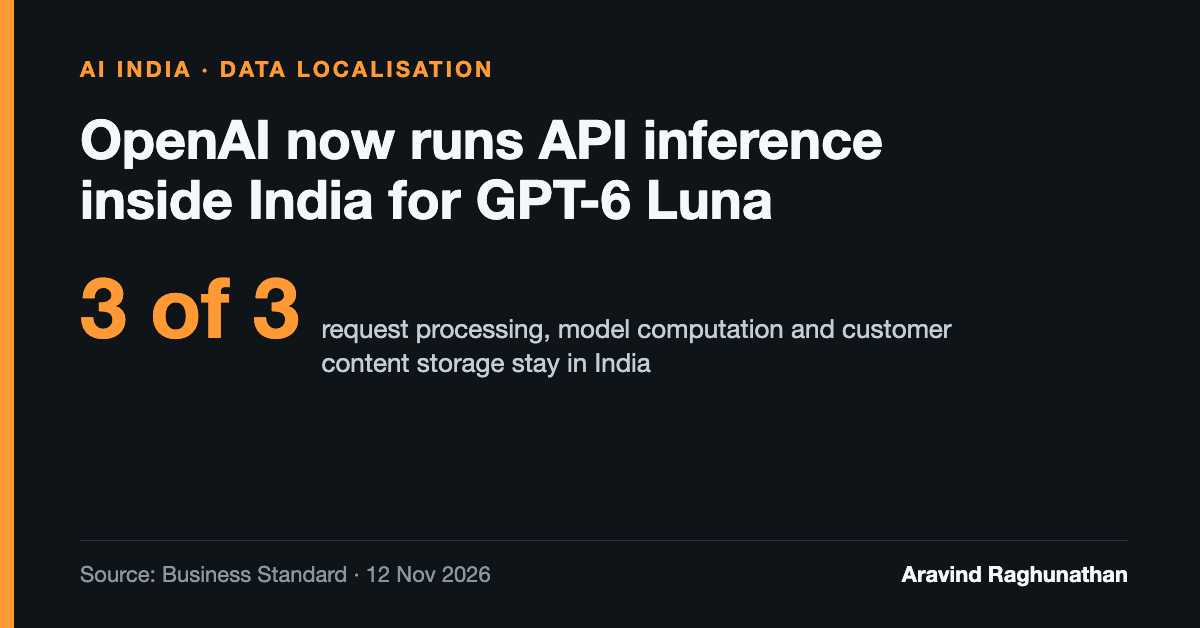
OpenAI has started processing API requests inside India. Eligible businesses and developers can now run supported workloads on its GPT-6 Luna model in the country, and the request handling, the model computation and the stored customer content all stay on Indian soil.
It reads like an infrastructure footnote. For many Indian enterprises, it's the reason AI projects have stayed in pilot.
What OpenAI actually launched
The change covers direct API use. For now, local processing supports GPT-6 Luna input and output through the Responses and Chat Completions APIs. To use it, a customer creates a new API project, picks India for both storage and processing, and calls the India regional endpoint.
OpenAI is pitching it at text-heavy work: summarising documents, drafting responses, and helping employees analyse information. India joins Australia and Japan as the most recent additions to OpenAI's API inference residency, which already runs in other regions.
Why where inference runs matters
Nitin Bawankule, OpenAI's Head of Enterprise for India, put the problem plainly: some Indian businesses have not deployed AI for important work because they need the data processed in the country. OpenAI itself said where AI processes information can decide whether an application reaches production, and called out financial services customers with specific localisation requirements.
In large Indian enterprises the model is rarely the blocker. The blocker is the conversation with risk, compliance and the regulator about where a customer's data travels when an employee pastes it into a prompt. Banks, NBFCs and insurers work under localisation expectations that make an offshore inference call hard to sign off, no matter how good the model is.
What changes for enterprise teams
If you run AI programmes in India, four things follow:
- Pilots parked on data residency can be re-opened. If a use case stalled because inference happened abroad, the architecture question now has a different answer, at least for supported workloads.
- Read the scope carefully. This is one model, two APIs and a new project setting. Anything outside that boundary is not covered, and existing projects do not move automatically.
- Residency is not the whole compliance story. Local processing answers where the computation happens. Access control, logging, retention and vendor risk still need their own review.
- Expect competitors to follow. Once one frontier lab offers in-country inference, it becomes a line item on every Indian enterprise RFP.
Beyond compute
India's AI conversation has mostly been about compute capacity and homegrown models. Inside regulated industries, adoption often turns on duller questions: where the data sits, who can see it, and whether the auditor will accept the answer. OpenAI moving inference into the country removes one of those objections. Now we find out how many stalled pilots were waiting on this, and how many were stalled for other reasons.
Source: Business Standard: OpenAI to process AI requests in India to meet data localisation needs