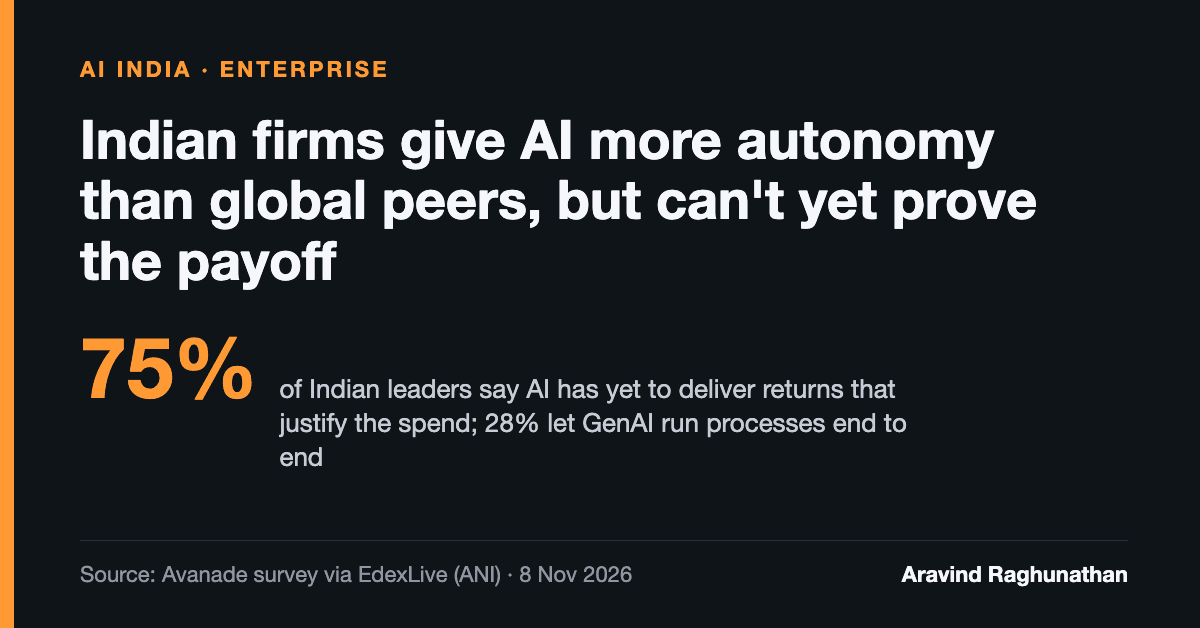
Indian companies let AI run more of their work unsupervised than the average across the markets surveyed, but most of them cannot yet show the spending paid off. That's the main finding of a new survey from Avanade, the Microsoft-focused services firm, reported by ANI on 8 November 2026.
What the survey found
Avanade's research, run by Vanson Bourne, interviewed 3,600 business decision-makers in August and September 2026. All came from organisations with global revenues above USD 500 million, across the Americas, Europe, the Middle East, India and Asia-Pacific.
On autonomy, India is well ahead of the average:
- 28% of Indian leaders say generative AI in their teams completes defined processes end to end without routine human approval. The average across all markets is 19%.
- Only 24% say their organisations require explicit human approval before generative AI acts, against 29% globally.
- 82% have high or complete confidence in how their organisation uses AI.
India also ranked first on operational gains: 44% report significant, measurable gains in operational efficiency (36% across markets) and 42% report significant productivity gains (36% globally).
The gap: returns
The returns picture is different. 75% of Indian respondents say AI has yet to deliver returns that justify the money and effort. 74% say their organisation has not formally calculated AI ROI and had it reviewed by finance or senior leadership. And only 23% say their teams have fundamentally reshaped how they work around AI.
The barriers are the usual ones: 48% point to integrating AI with existing core systems and data, while 41% cite data, cloud or integration limits.
Achal Kataria, MD and CEO of Avanade India, said Indian enterprises are moving past pilots faster than any other market and that the next step is proving the value in financial terms.
Why this matters
I'd read this in two ways.
The autonomy figure is a governance question before it is a productivity one. If more than a quarter of Indian teams let generative AI finish processes without a human sign-off, then the controls around those processes (logging, exception handling, rollback, who is accountable when it goes wrong) carry more weight than the model choice. Running with fewer approval gates than the global average is a risk position, and boards should know they've taken it.
The ROI gap, meanwhile, is mostly a measurement gap. Efficiency gains that no one has costed and finance has not reviewed are hard to defend when budgets tighten. The 74% who have not formally calculated returns are not necessarily failing. They just haven't done the accounting that would tell them either way.
A sensible next step: take the AI workflows that already run without approval, baseline their cost and cycle time, and have finance sign off on the numbers. Then the 82% confidence figure has something behind it.
Source: Indian firms embrace AI autonomy but struggle to prove financial gains: Report (EdexLive / ANI)