AI Begins Before AI: What I Told the BusinessWorld Manufacturing Roundtable
At a BusinessWorld roundtable with IBM, Redington and CMEX, I argued that AI work in manufacturing starts long before the AI itself — with data, machine connectivity and the shopfloor knowledge nobody has written down.
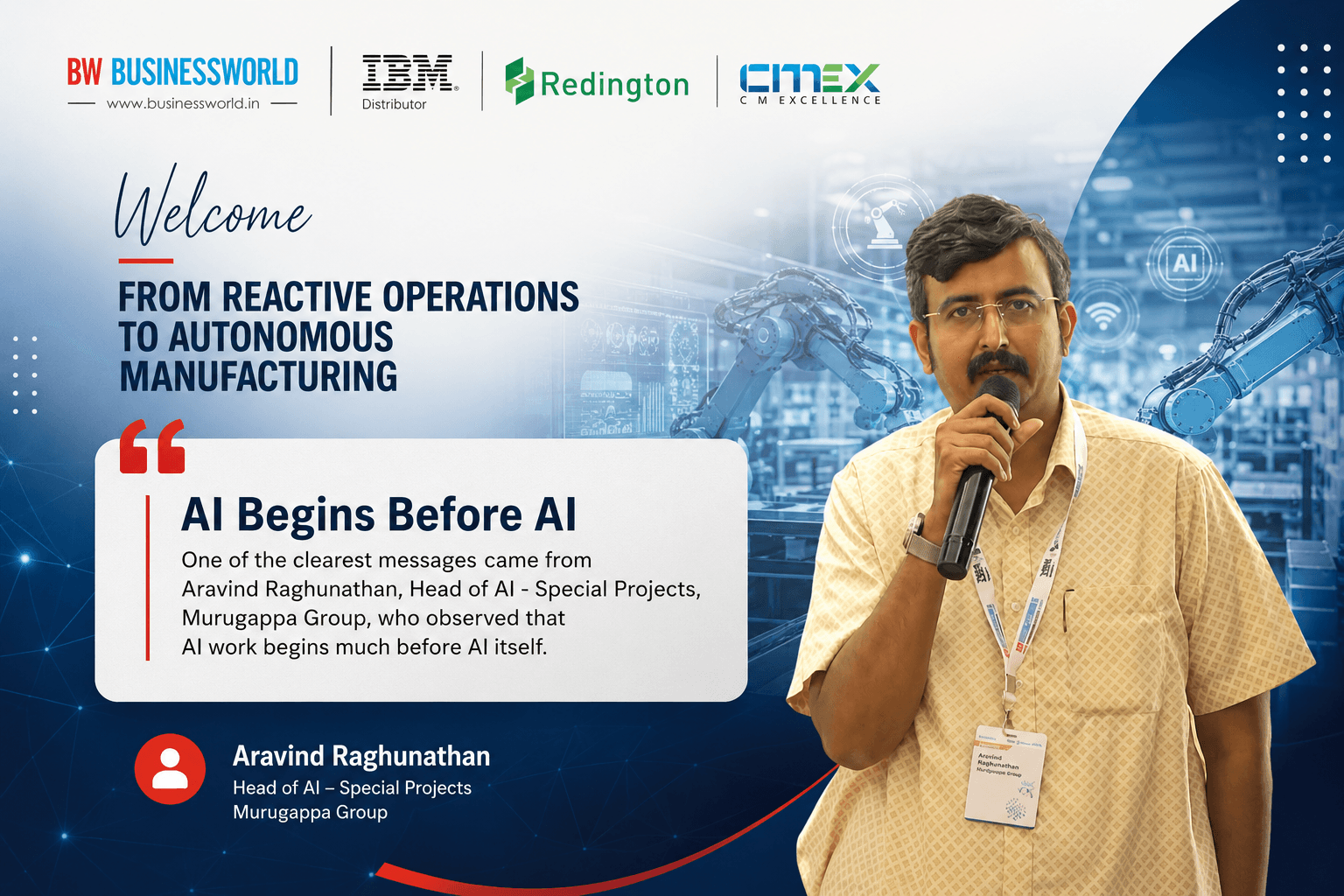
I spoke at a BusinessWorld roundtable on "From Reactive Operations to Autonomous Manufacturing," supported by IBM, Redington and CMEX, alongside leaders from TTK Healthcare, Tagros Chemicals, Thejo Engineering, JK Fenner, Carborundum Universal and KP Manish Global Ingredients.
The framing question was not whether AI works. It was whether factories are ready to make autonomous manufacturing mean anything.
My answer, and the line the write-up led with: AI work begins much before AI itself. The first challenge is data.
Old machines are not the problem people assume
There's a temptation to treat legacy equipment as the blocker. It usually isn't.
Newer businesses may already have IoT systems, connected assets and reasonably clean data fields. Older plants often run machines that are decades old and still delivering output — and in those cases the business doesn't want to replace the machine. It wants to monitor it better, cut maintenance costs, see downtime coming, and understand what happens to the customer if that machine stops.
That is a different problem from modernisation, and it's the one that pays. It also puts IoT, sensors, SCADA systems and data pipelines at the centre of the work, rather than the model sitting on top of them.
The fragmented-journey trap
Sequencing is where I'd push back hardest.
Many IoT journeys stay fragmented. A company starts with automation, adds sensors in a few areas, and then suddenly faces pressure to implement AI quickly. What results is a collection of disconnected initiatives rather than a structured path from data capture, to insight, to autonomous action.
That pressure is real, and it usually comes from the top. But dropping an AI initiative onto an incomplete data foundation doesn't shortcut the foundation. It defers the gap, and the gap gets more expensive the later you find it.
The knowledge that isn't written down
If a plant leader takes one thing from this, I'd rather it be about knowledge than technology.
SOPs exist in most plants. They often do not reflect what actually happens during production. The knowledge that matters — why this batch is behaving differently, what that sound means, when to step in early — sits with plant heads, supervisors and experienced operators.
If it is never written down, a model cannot learn it. You can have clean sensor data and still miss what an experienced supervisor catches in seconds, because the reasoning behind the catch was never recorded anywhere a system could read.
Past dashboards
The wider discussion landed on a related shift. Dashboards were once the milestone of digitisation, but visibility on its own doesn't get you to autonomous manufacturing. The system has to help decide what to produce, when to intervene, how to optimise energy, and where quality or maintenance risk is building.
Governance closed the conversation, and in manufacturing that isn't only a personal-data question. Product designs, recipes, formulations and R&D documents are industrial IP, and they can't be casually exposed to ungoverned tools.
None of this argues for going slower. It argues for doing the unglamorous part first, because that is what decides whether the AI layer has anything solid underneath it.
Source: From Reactive To Autonomous Manufacturing — BusinessWorld