142,000 Stars for a Folder Full of Markdown
One of the most starred AI repositories on GitHub right now contains almost no code. `agency-agents` by Matt Sitarzewski holds roughly 142,000 stars and 23,100 forks for what is structurally a collection of Markdown files.
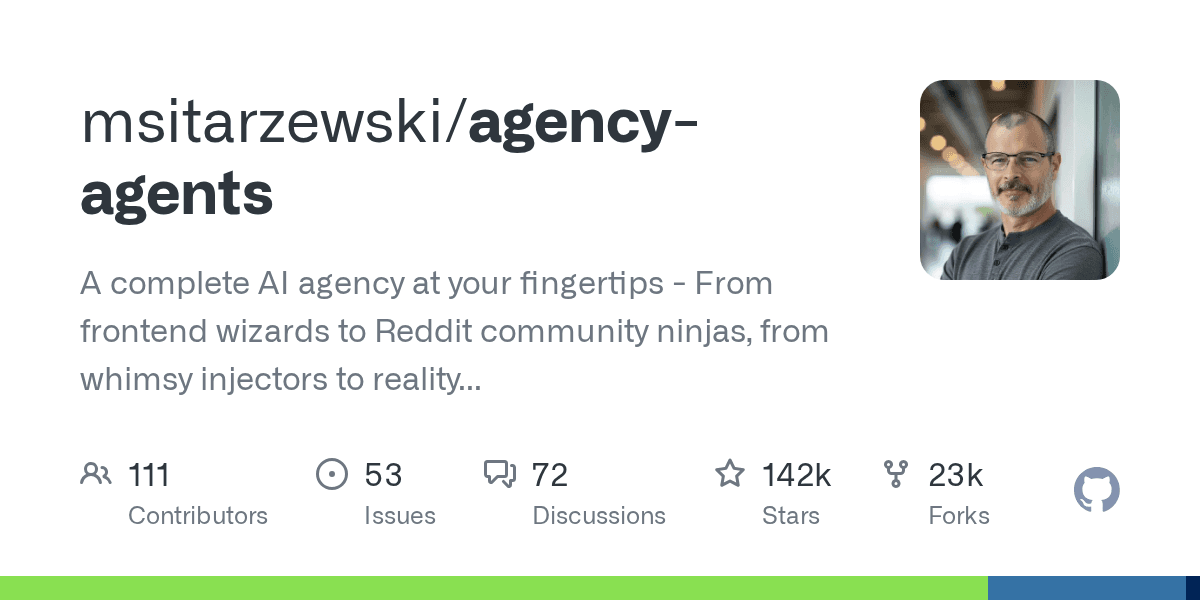
One of the most starred AI repositories on GitHub right now contains almost no code. agency-agents by Matt Sitarzewski holds roughly 142,000 stars and 23,100 forks for what is structurally a collection of Markdown files.
The gap between substance and popularity is the interesting part.
Contents
The project bills itself as "a complete AI agency at your fingertips" — 230-plus specialised AI agent personalities sorted into divisions that read like a company org chart. Engineering, design, marketing, product, sales, finance, security, testing, project management, healthcare, academic, game development, GIS, spatial computing.
Each agent is described as specialised rather than generic, personality-driven, deliverable-focused and production-ready, with documented workflows and success metrics.
It grew, per the README, out of a Reddit thread and months of iteration. There is now a native app for macOS, Linux and Windows that browses the roster and installs agents into Claude Code, Cursor, Codex, Gemini and others with one click. No cloning, no scripts, auto-updating.
How prompts became infrastructure
Easy to be dismissive. These are prompts in files. No novel algorithm, no model, no framework.
That reaction misses what shifted. Once coding agents could load role definitions from a directory, a well-written prompt stopped being something you type and became something you install. Versioned. Forkable. Reviewable through pull requests. Distributed through the same channels as any other dependency.
The 23,100 forks make the point better than the stars do. People are not bookmarking this, they are taking it and changing it. That is how dependencies get used.
Where the claims outrun the evidence
"Battle-tested workflows and success metrics" is a strong assertion, and the repository structure cannot support it. Nothing here is validated in a way an outsider could check. A folder of confidently written role definitions is not evidence those roles beat a competent engineer writing their own prompt for their own context.
The format carries a subtler risk too. A pre-packaged expert persona invites you to skip the work that makes prompts effective — understanding your problem well enough to specify it precisely. Borrowed specificity is not specificity.
Useful reading, questionable dependency
Treat it as a reference corpus. The value sits in seeing how several hundred role definitions are structured: what a good one contains, how constraints get expressed, where deliverables are named concretely. Then write your own against your codebase and conventions.
The wider signal outruns the repository itself. Prompt libraries are now distributed, versioned and installed like software packages, with app stores forming around them. Which drags in every question we ask of any dependency. Who maintains this. What review happens before a merge. How would I notice if an update quietly changed my agent's behaviour. What is the supply-chain exposure of installing a stranger's instructions into a tool that can read and write my code.
Those questions do not have good answers yet, and the install counts are not waiting for them.